Seasonal Strategy
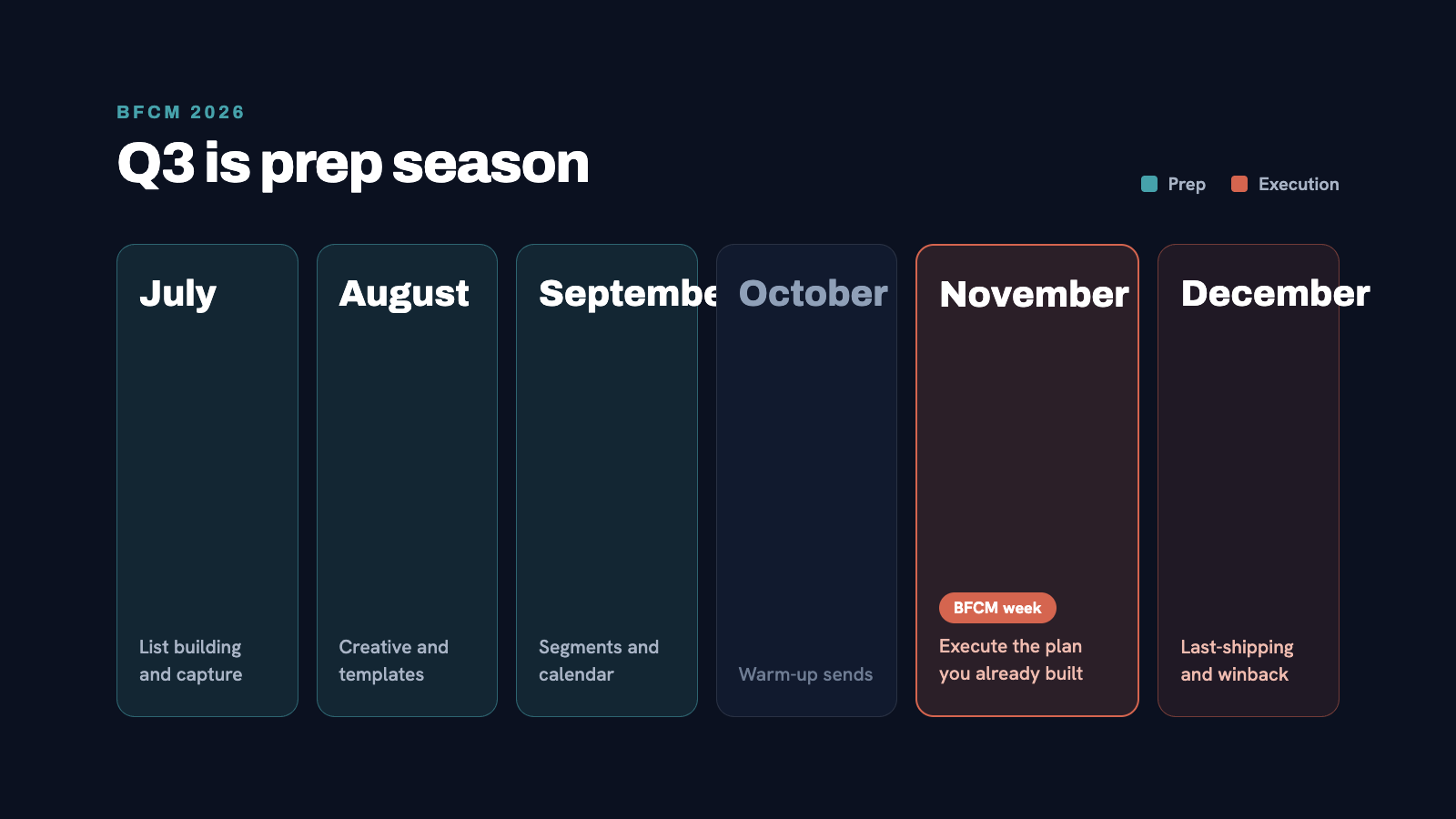
Most DTC brands start thinking about Black Friday in October. The brands that win BFCM start in July.
That's not an exaggeration. The top-performing DTC operators treat Q3 as a distinct season - not for selling, but for building the infrastructure, testing the creative, and growing the list that will convert when the highest-traffic, highest-CPM window of the year arrives.
Every week of testing between now and Black Friday either sharpens your account or leaves it flying blind into the biggest spend weeks of the year.
Q4 is not the time to test. CPMs spike 30-50% above baseline during BFCM week. Ad costs are at their highest. Audiences are at their most competitive. Running creative tests when your cost per test is double or triple what it would be in August is expensive, slow, and risky.
Q3 has lower volume, lower competition, and lower stakes. It's the ideal environment to answer the questions your Q4 campaigns depend on:
• Which creative angles actually convert for your audience?
• What does your quiz funnel conversion rate look like at steady state?
• What's your welcome flow conversion rate for paid traffic vs. organic?
• Which audience segments perform best on Meta?
• What subject lines drive the highest open rates on your list?
Answer those questions in Q3 with cheap data. Execute in Q4 with confidence.
Paid media:
• Run A/B tests on at least two creative angles per ad set now. You need to know your winner before CPMs spike.
• Test Meta's new customer purchase optimization tool against your current approach. Know which performs better for your account before BFCM.
• Build your warm audiences now - website visitors, add-to-cart, initiate-checkout. The larger and more recent these audiences are by November, the more effective your BFCM retargeting will be.
• Review your campaign structure and simplify. Overlapping ad sets fragment learning. Clean accounts outperform messy ones during high-volume periods.
Email and SMS:
• Grow your email and SMS list aggressively now. Every subscriber added in Q3 will be warmed up and engaged by Q4. Every subscriber added in October will barely be through their welcome flow before BFCM.
• Run a list re-engagement campaign for anyone who hasn't opened in 90 days. You want a clean, engaged list going into Q4 - not a bloated one that tanks your deliverability when you need it most.
• Build your BFCM email and SMS templates now. Don't write them on November 25.
• Set up your post-BFCM flows. The week after BFCM is one of the highest new-customer moments of the year. If you don't have a strong post-purchase sequence in place, you'll convert buyers once and never see them again.
Site and funnel:
• Run a load test on your site. Traffic spikes during BFCM can slow or crash sites that aren't prepared.
• Optimize your checkout for mobile. The majority of BFCM traffic is mobile.
• Review your email capture popup and offer. The months leading up to BFCM are when you want to be building list fastest.
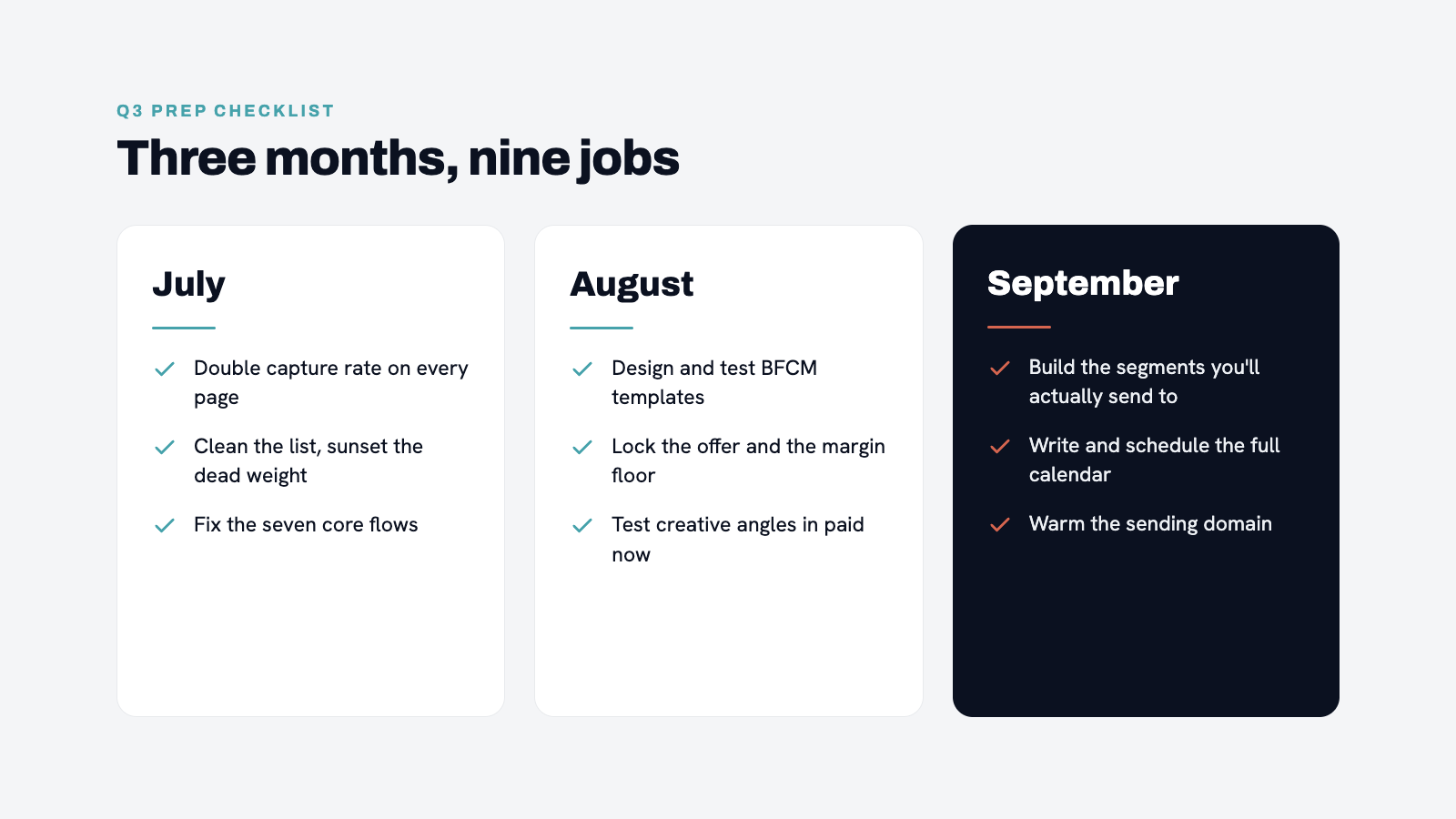
The most common BFCM failures don't happen in November. They happen in Q3 when brands don't prepare.
Starting promotions too late. Email list building should peak in October, not November. By the time BFCM arrives, your new subscribers should have been through a welcome sequence, received several campaigns, and developed trust with your brand.
Not testing creative early enough. Brands that head into BFCM without proven creative are spending at peak CPMs to run experiments. That's the most expensive way to discover what doesn't work.
Discounting too aggressively. Brands that go deep on BFCM discounts train their customers to wait for the deal every year. Your Q3 is the time to think about your offer strategy - what discount structure works for your margins, and how to create urgency without conditioning your list to expect a sale every November.
Ignoring post-BFCM retention. BFCM is a massive new customer acquisition event. If you don't have flows built to retain those buyers, you'll spend a fortune acquiring them and watch them churn.
If you're starting Q3 prep now and have limited bandwidth, here's the order of operations:
1. Creative testing on Meta - you need at least eight weeks of data before BFCM to make meaningful decisions
2. List growth push - an extra 5,000 subscribers added in August is worth more than 5,000 added in October
3. Post-purchase flow audit - make sure the sequence that runs after your BFCM orders is ready to convert one-time buyers into repeat customers
Everything else is important. But those three things determine your BFCM ROI more than anything else you could do.
Lorem ipsum dolor sit amet, consectetur adipiscing elit. Suspendisse varius enim in eros elementum tristique. Duis cursus, mi quis viverra ornare, eros dolor interdum nulla, ut commodo diam libero vitae erat. Aenean faucibus nibh et justo cursus id rutrum lorem imperdiet. Nunc ut sem vitae risus tristique posuere.How to Build Your BFCM Email and SMS Strategy Before October
Lorem ipsum dolor sit amet, consectetur adipiscing elit. Suspendisse varius enim in eros elementum tristique. Duis cursus, mi quis viverra ornare, eros dolor interdum nulla, ut commodo diam libero vitae erat. Aenean faucibus nibh et justo cursus id rutrum lorem imperdiet. Nunc ut sem vitae risus tristique posuere.Ecommerce Email Flows: The 7 Automations Every DTC Brand Needs (2026 Guide)
Lorem ipsum dolor sit amet, consectetur adipiscing elit. Suspendisse varius enim in eros elementum tristique. Duis cursus, mi quis viverra ornare, eros dolor interdum nulla, ut commodo diam libero vitae erat. Aenean faucibus nibh et justo cursus id rutrum lorem imperdiet. Nunc ut sem vitae risus tristique posuere.What Is Marketing Efficiency Ratio (MER) - and Why Every DTC Brand Should Track It
Not sure if your paid and email setup is ready for Q4?
Our growth diagnostic covers both channels and shows you exactly what needs to be in place before BFCM. Free for qualified brands - spots are limited in Q3.
Book your free growth diagnostic →