Email and SMS
Ecommerce email flows are the highest-leverage automations a DTC brand can build - automated sequences triggered by customer behavior that generate revenue 24 hours a day without manual effort after setup. Most DTC brands put their lifecycle marketing energy into campaigns - the weekly email, the promotional SMS, the flash sale. Campaigns are visible. They show up on a calendar. They produce revenue you can point to on a specific day.
Email flows are different. They run in the background, triggered by customer behavior, generating revenue around the clock without anyone pressing send. They are also where most DTC brands leave the most money on the table - not because the technology is hard, but because nobody ever sat down and built them properly.
A campaign works once. A flow works every time the trigger fires.
Ecommerce email flows are automated sequences triggered by customer behavior - a signup, an abandoned cart, a completed purchase - that send the right message at the right moment without anyone pressing send. Unlike campaigns, which you schedule and send manually, flows run 24/7 and generate revenue automatically after setup.
According to Klaviyo benchmark data, automated flows produce an average of $3.65 revenue per recipient compared to just $0.11 for broadcast campaigns - a 33x difference. Despite this, most DTC brands have two or three flows running at most.
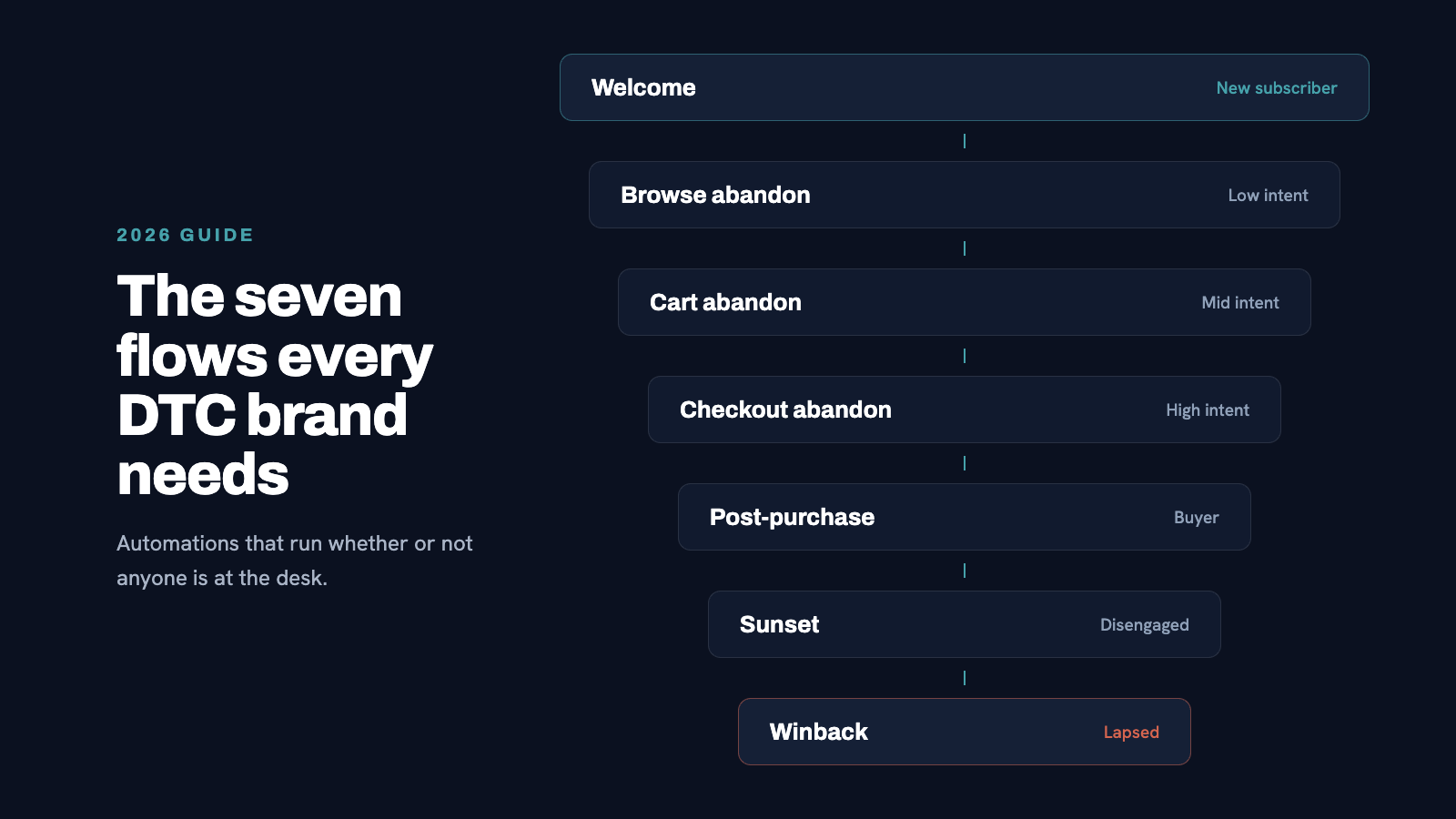
Here are the seven flows every ecommerce brand needs, what each one does, and what it costs you not to have it.
Flow
Moment It Addresses
Primary Channel
1. Welcome
New subscriber, pre-purchase
Email + SMS
2. Abandon Stack
Browse, cart, and checkout drop-off
Email + SMS
3. Post-Purchase
First 30 days after buying
4. Winback
Lapsing or lapsed customer
Email + SMS
5. Sunset
Chronically unengaged subscriber
6. Back-in-Stock
Interest in an out-of-stock product
Email + SMS
7. Birthday / VIP
High-value customer milestones
Email + SMS
The first three are non-negotiable. If those aren't running and working, nothing else matters. Flows four through seven extend the customer relationship, protect list health, and capture high-intent signals most brands ignore.
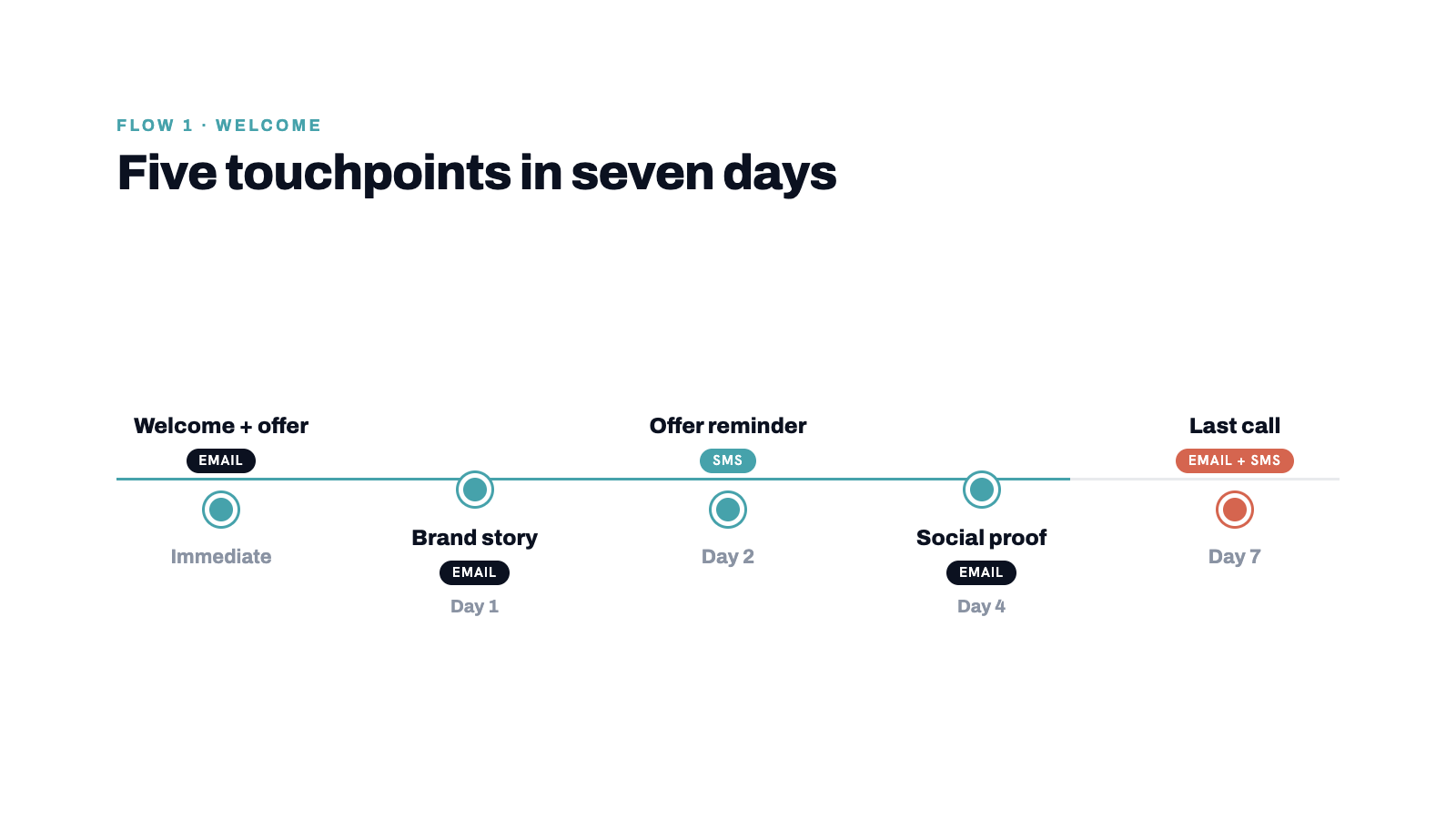
The welcome window is the highest-attention, highest-intent moment in the customer relationship. A new subscriber opens your first email at two to four times the rate they'll open your fifth. That attention never comes back.
Most welcome flows deliver a discount code and go quiet. A working welcome flow delivers the offer, builds brand preference, addresses the most common pre-purchase objection, and creates a clear path to the first purchase - all before the interest that drove the sign-up fades.
What it earns you: Brands with a structured five-touch welcome sequence convert subscribers at twice the rate of brands running a default two-email template. On a list adding 1,000 new subscribers per month at a $65 AOV, that difference is worth thousands in additional monthly revenue.
What it costs you not to have it: Every subscriber who joins your list and doesn't convert in the first seven days is significantly harder to convert later. The decay in open rates and intent after the welcome window closes is steep.
Most brands run one cart abandonment email. That's not a strategy - it's a single touchpoint in a journey that starts much earlier and ends much later.
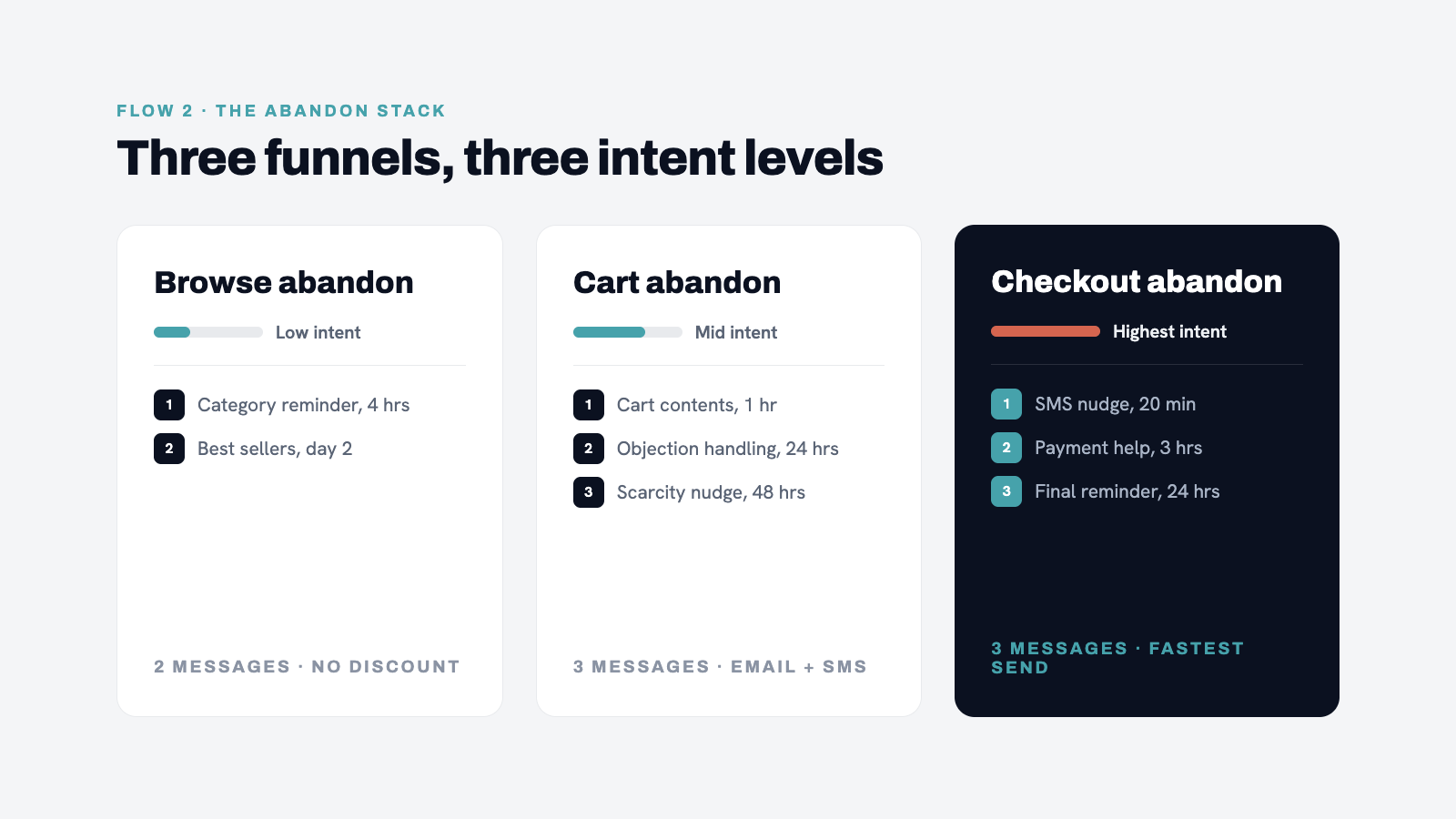
The abandon stack is three separate flows, each targeting a different stage of purchase intent:
• Browse abandon catches interest before commitment
• Cart abandon re-engages when intent is high but something stopped the purchase
• Checkout abandon recovers the highest-intent drop - people who entered their payment information and still didn't buy
What it earns you: Most brands recover 3% of abandoned carts with a single email. The full three-flow stack recovers 8-12% of the same traffic. For a brand doing $100K per month, that difference is significant - and it comes from traffic you already paid to acquire.
What it costs you not to have it: Every session that abandons without a recovery flow is paid traffic with no second chance.
The sale is not the win. What happens in the next 30 days is.
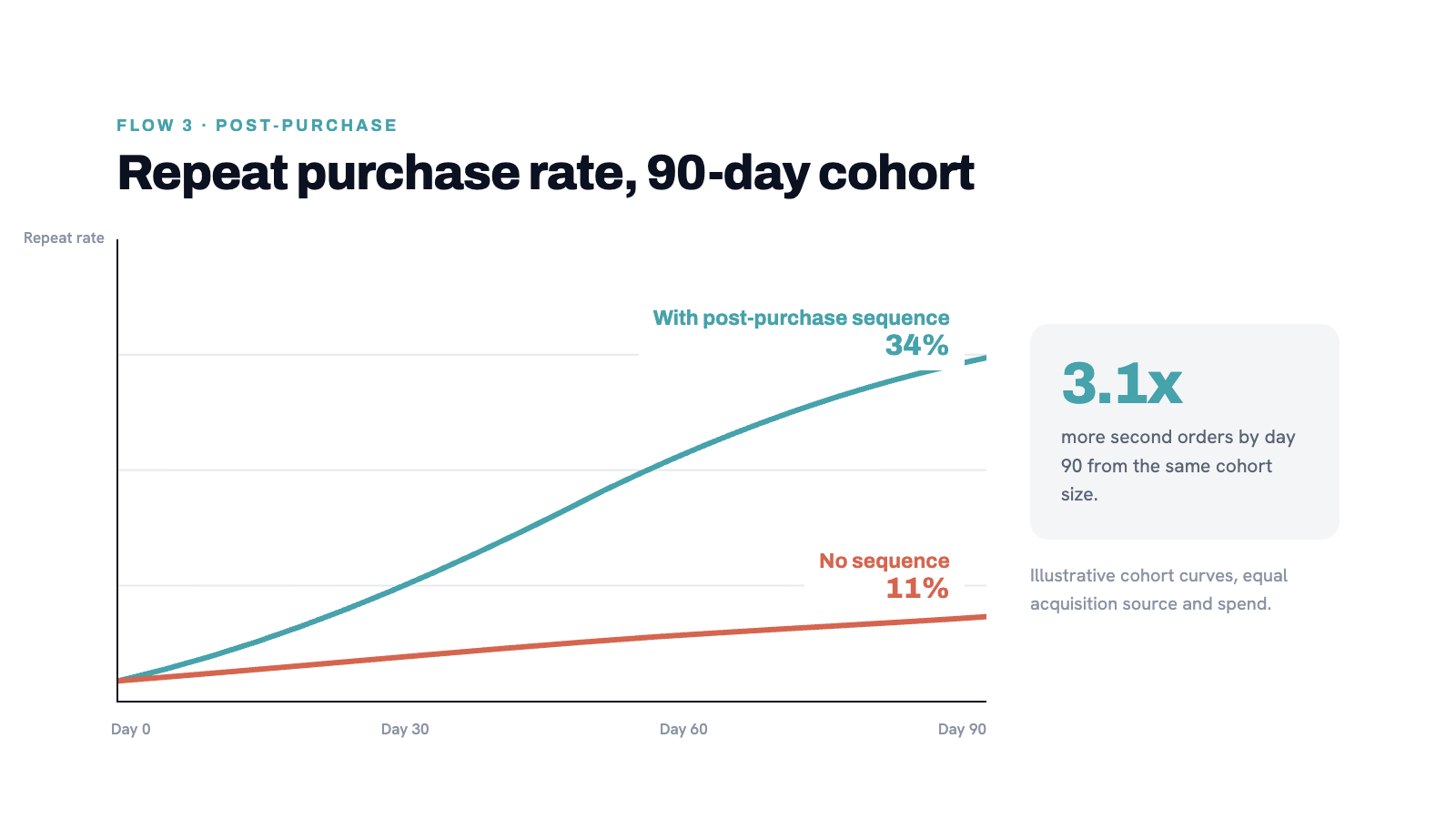
A first-time buyer who doesn't make a second purchase within 30 to 60 days has less than a 15% chance of becoming a long-term customer. The post-purchase window is when habits form - and it closes whether you build for it or not.
A working post-purchase sequence validates the purchase decision, educates on product use, captures reviews at the right moment, introduces complementary products, and earns the second order before the customer goes quiet.
What it earns you: A structured 30-day post-purchase sequence consistently moves the 30-day repeat rate from the high teens to the low-to-mid thirties. At a $45 CAC, that lift generates significant additional contribution margin from customers you already acquired.
What it costs you not to have it: You're paying full CAC for customers who will churn before they ever clear payback.
Lapsing customers are one of the highest-value segments you own. They already know your brand. They've already paid you once. The barrier is recency, not awareness.
A working winback flow identifies at-risk buyers before they're fully gone, delivers a sequence designed to reactivate them, and moves unresponsive contacts to the sunset flow rather than continuing to email them indefinitely.
What it earns you: Reactivating a lapsed customer costs a fraction of acquiring a new one. A winback flow converting 5-10% of lapsing customers generates meaningful incremental revenue from a segment most brands have written off.
What it costs you not to have it: Without a winback flow, lapsing customers simply leave. There is no second chance, no reactivation offer, no reason to return.
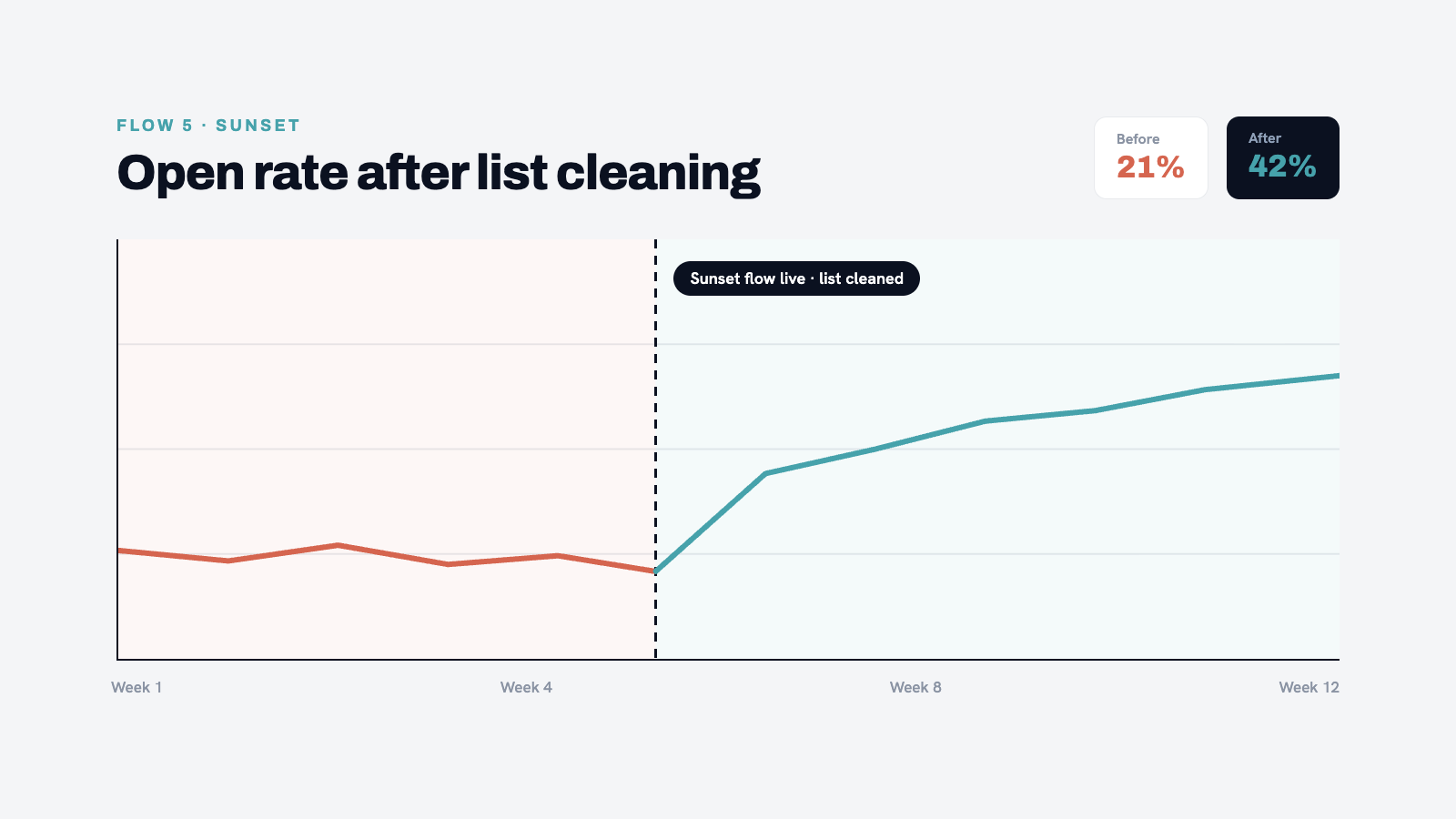
Sending to unengaged subscribers is one of the quietest ways to destroy your email program. It suppresses your open and click rates, signals to inbox providers that your mail isn't wanted, and gradually degrades deliverability for everyone on your list.
The sunset flow gives disengaged contacts a final opportunity to confirm they want to keep hearing from you - and cleanly removes those who don't.
What it earns you: A clean, engaged list. Your campaigns and flows reach more of the subscribers who actually want them. Your metrics reflect reality instead of a bloated list with thousands of dead addresses dragging everything down.
What it costs you not to have it: A list of 50,000 engaged subscribers outperforms a list of 200,000 that's never been cleaned. List hygiene is not a vanity exercise - it's a deliverability infrastructure decision.
Back-in-stock flows are among the highest-converting in any DTC program. The subscriber self-selected their interest. The notification is the exact message they asked to receive.
What it earns you: Back-in-stock flows consistently produce open rates above 60% and conversion rates above 20% - multiples of what typical campaign sends achieve. Every out-of-stock product without a waitlist and notification flow is a missed capture of high-intent demand.
What it costs you not to have it: A customer who wanted a product and couldn't get it simply leaves. The demand was real. The infrastructure to capture it was not.
VIP customers represent a disproportionate share of revenue in almost every DTC brand. The top 20% typically generate 60-80% of total revenue. A flow that recognizes and rewards that segment - with early access, exclusive offers, or simply an acknowledgment - increases purchase frequency and reduces churn in the cohort that matters most.
What it earns you: Treating your best customers like your best customers. The birthday flow creates a genuine one-to-one moment. The VIP threshold flow makes loyal customers feel seen before they find a brand that does.
What it costs you not to have it: High-value customers have more options and higher expectations. A brand that never acknowledges their loyalty is a brand they'll eventually replace with one that does.
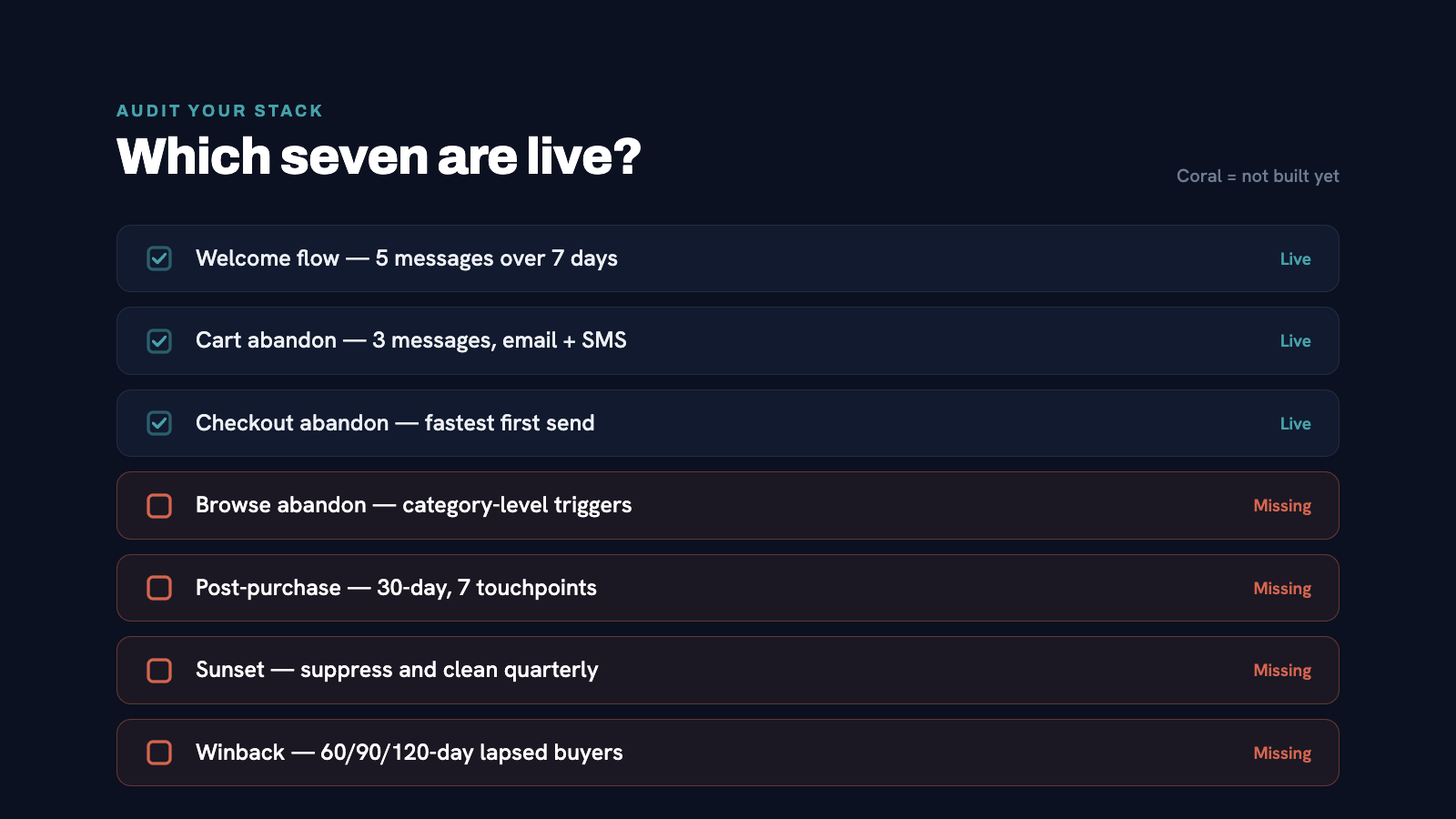
For each flow, the question is binary: is it running, and is it working?
• Do you have a welcome flow with more than two emails and a defined conversion goal?
• Do you have all three abandon flows running separately - browse, cart, and checkout?
• Do you have a 30-day post-purchase sequence that goes beyond the order confirmation?
• Do you have a defined winback trigger and a suppression rule for non-responders?
• Do you have a sunset flow that actually removes chronically unengaged subscribers?
• Do you have a back-in-stock notification flow on your out-of-stock products?
• Do you have a defined VIP threshold and a flow that fires when customers cross it?
Three or more nos means your flow stack is leaving meaningful revenue on the table every month.
What are the most important ecommerce email flows?
The five foundational flows every ecommerce brand needs before anything else are: the welcome flow, the cart abandon flow, the checkout abandon flow, the post-purchase sequence, and the winback flow. Get these running and optimized before building additional flows.
How many email flows does a DTC brand need?
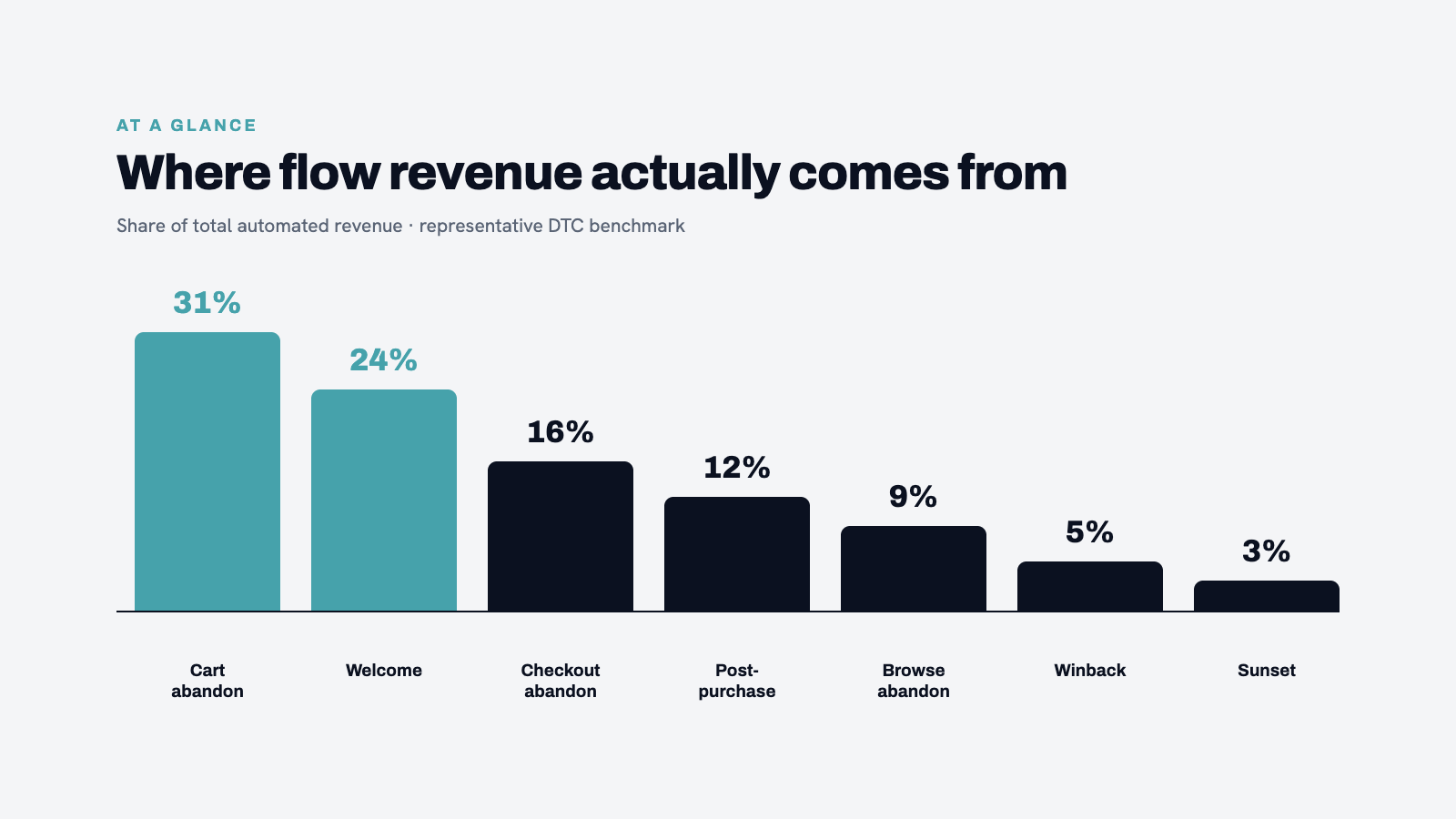
Most DTC brands have two to three flows running. The brands generating 30-45% of total revenue from email consistently have seven or more active flows covering every high-intent moment in the customer lifecycle.
What is the difference between email flows and campaigns?
Campaigns are manually scheduled and sent to a list on a specific date. Flows are automated sequences that trigger based on customer behavior - a signup, a cart add, a purchase, or inactivity. Flows generate revenue continuously without any ongoing effort after setup.
How much revenue should ecommerce email flows generate?
In a mature Klaviyo program, flows typically generate 60-80% of total email revenue, with campaigns accounting for the remaining 20-40%. If campaigns are generating more than flows in your account, your automation infrastructure is underbuilt.
Lorem ipsum dolor sit amet, consectetur adipiscing elit. Suspendisse varius enim in eros elementum tristique. Duis cursus, mi quis viverra ornare, eros dolor interdum nulla, ut commodo diam libero vitae erat. Aenean faucibus nibh et justo cursus id rutrum lorem imperdiet. Nunc ut sem vitae risus tristique posuere.Email Welcome Flow for Ecommerce: How to Convert Subscribers into First-Time Buyers
Lorem ipsum dolor sit amet, consectetur adipiscing elit. Suspendisse varius enim in eros elementum tristique. Duis cursus, mi quis viverra ornare, eros dolor interdum nulla, ut commodo diam libero vitae erat. Aenean faucibus nibh et justo cursus id rutrum lorem imperdiet. Nunc ut sem vitae risus tristique posuere.Post-Purchase Email Sequence for Ecommerce: How to Increase Repeat Purchase Rate
Lorem ipsum dolor sit amet, consectetur adipiscing elit. Suspendisse varius enim in eros elementum tristique. Duis cursus, mi quis viverra ornare, eros dolor interdum nulla, ut commodo diam libero vitae erat. Aenean faucibus nibh et justo cursus id rutrum lorem imperdiet. Nunc ut sem vitae risus tristique posuere.How to Grow an Ecommerce Email List That Converts: DTC List Building Guide (2026)
Get the complete blueprint for all seven flows - free.
The DTC Flow Blueprint covers what each flow does, what it earns you, and what it costs you not to have it.
Download the DTC Flow Blueprint →