Paid Media Strategy
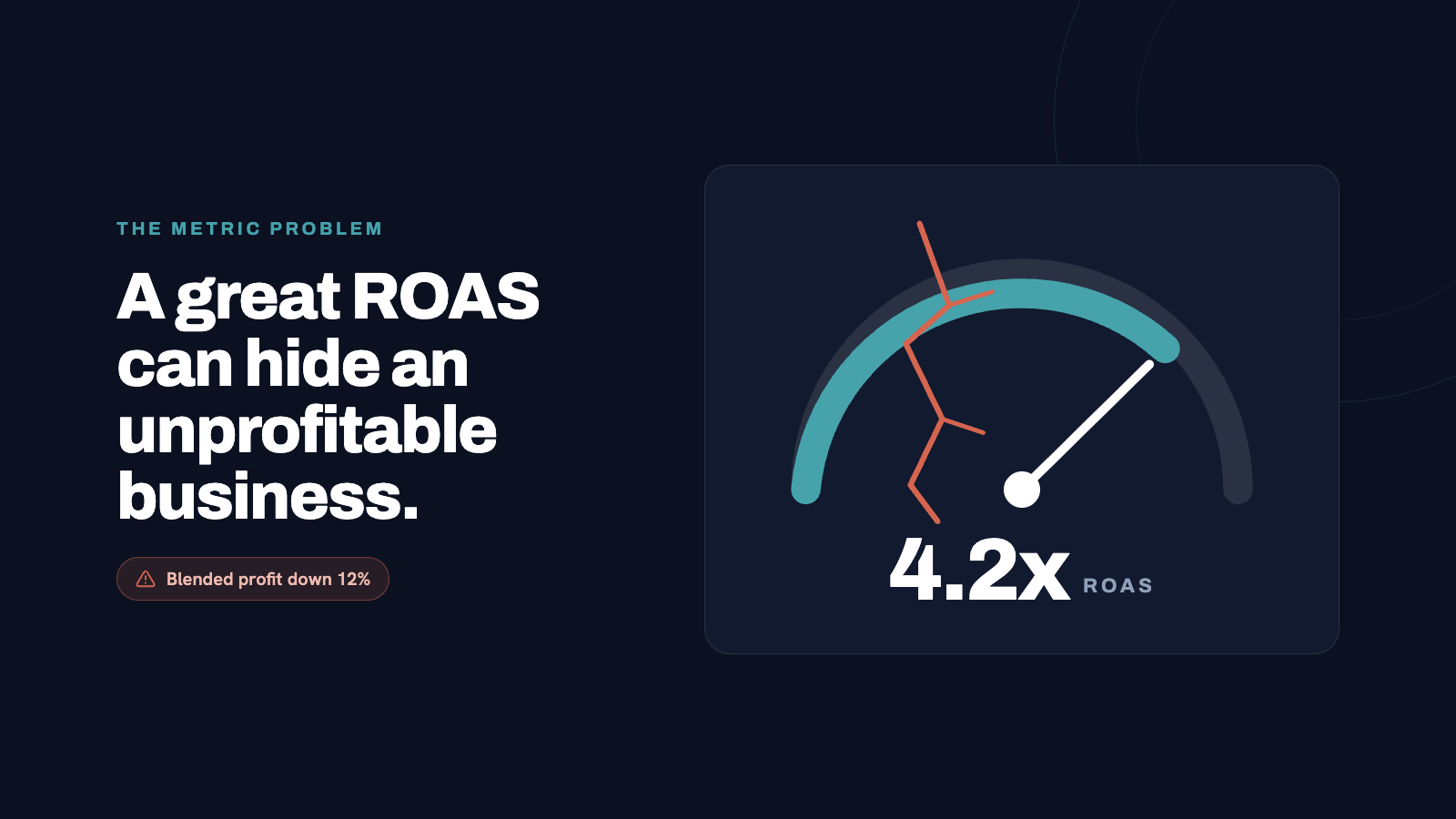
Most DTC founders check their ROAS every morning. It's the number that determines whether you scale or pull back, whether you trust your agency or fire them, whether you feel good or awful about Monday.
There's just one problem. That number is wrong.
Not slightly off. Not a rounding error. For most DTC brands in 2026, platform-reported ROAS overstates actual performance by 15 to 40 percent. And the brands building their growth strategy around it are making budget decisions based on a fiction.
Here's what's actually happening, and the metric you should be looking at instead.
ROAS is a platform metric. It measures what the ad platform wants to measure - conversions it can attribute to itself - not what your business actually did.
Three things make this number unreliable:
iOS privacy changes. Since Apple's App Tracking Transparency update, Meta and other platforms have lost visibility into a significant portion of the conversion path. They fill the gap with modeled conversions - statistical estimates of what probably happened. Those estimates tend to favor the platform.
Cross-device behavior. A customer sees your ad on their phone, thinks about it for two days, then buys on their laptop. The ad platform often can't connect those two events. Sometimes it counts the conversion anyway. Sometimes it doesn't. There's no consistent logic.
Attribution window overlap. Multiple channels - your Meta ads, your email, your Google Shopping campaigns - are all claiming credit for the same purchase. When you add up reported ROAS across your channels, the math rarely reconciles with your actual revenue.
The result: a 4x ROAS on your dashboard might be 2.8x in reality. The campaign you're scaling might be the one bleeding money.

The metric you want is MER - Marketing Efficiency Ratio.
The formula is simple:
MER = Total Online Revenue / Total Marketing Spend
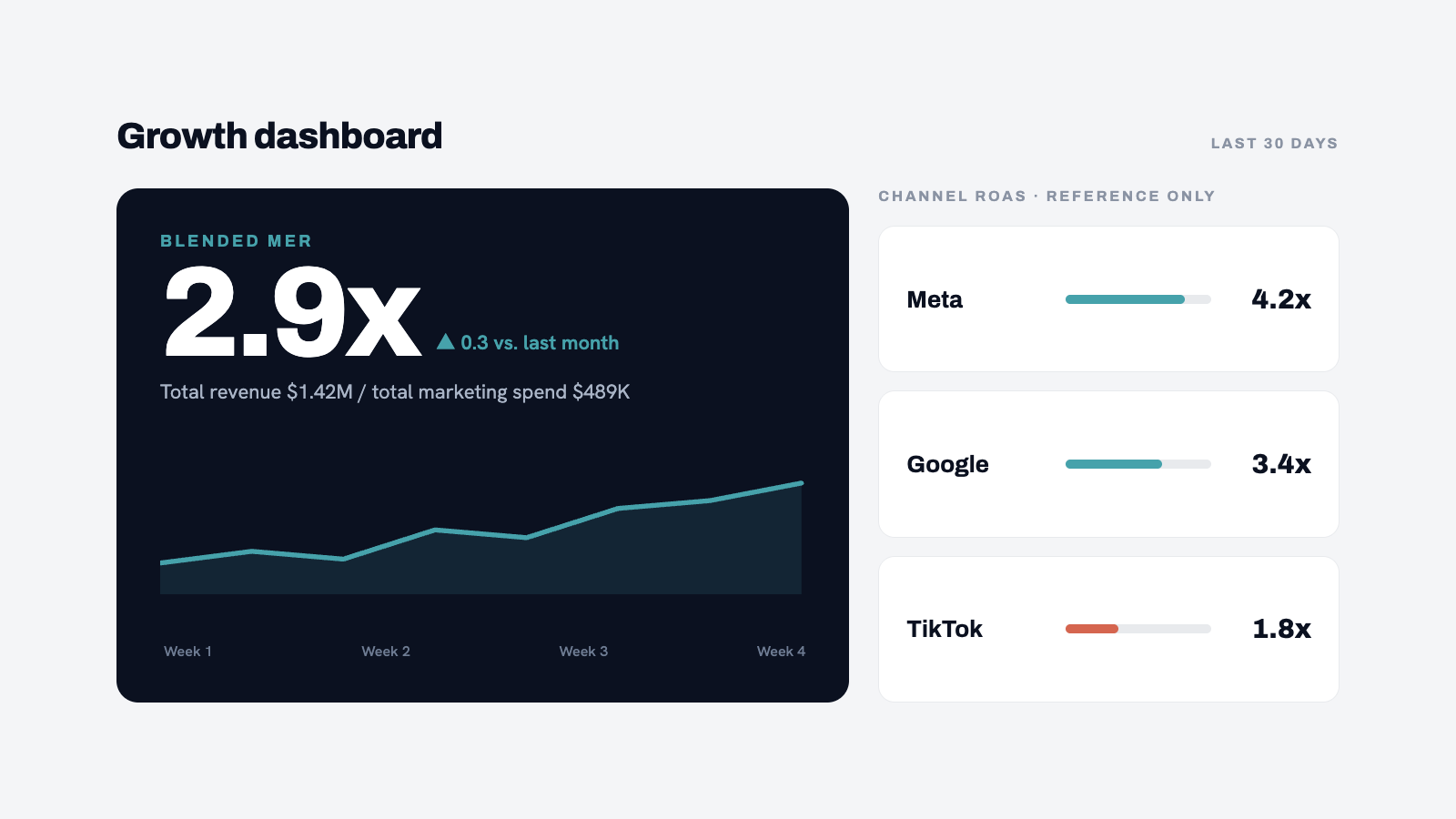
If your brand did $400,000 in revenue last month across all channels, and you spent $100,000 on marketing (Meta, Google, email, everything), your MER is 4.0x.
That's the real number. Not what one platform says it did. Not what your attribution model thinks happened. Total revenue against total spend - a ratio your business actually produced.
MER doesn't lie because it can't. It's not pulling from a model or crediting a guess. It's your P&L.
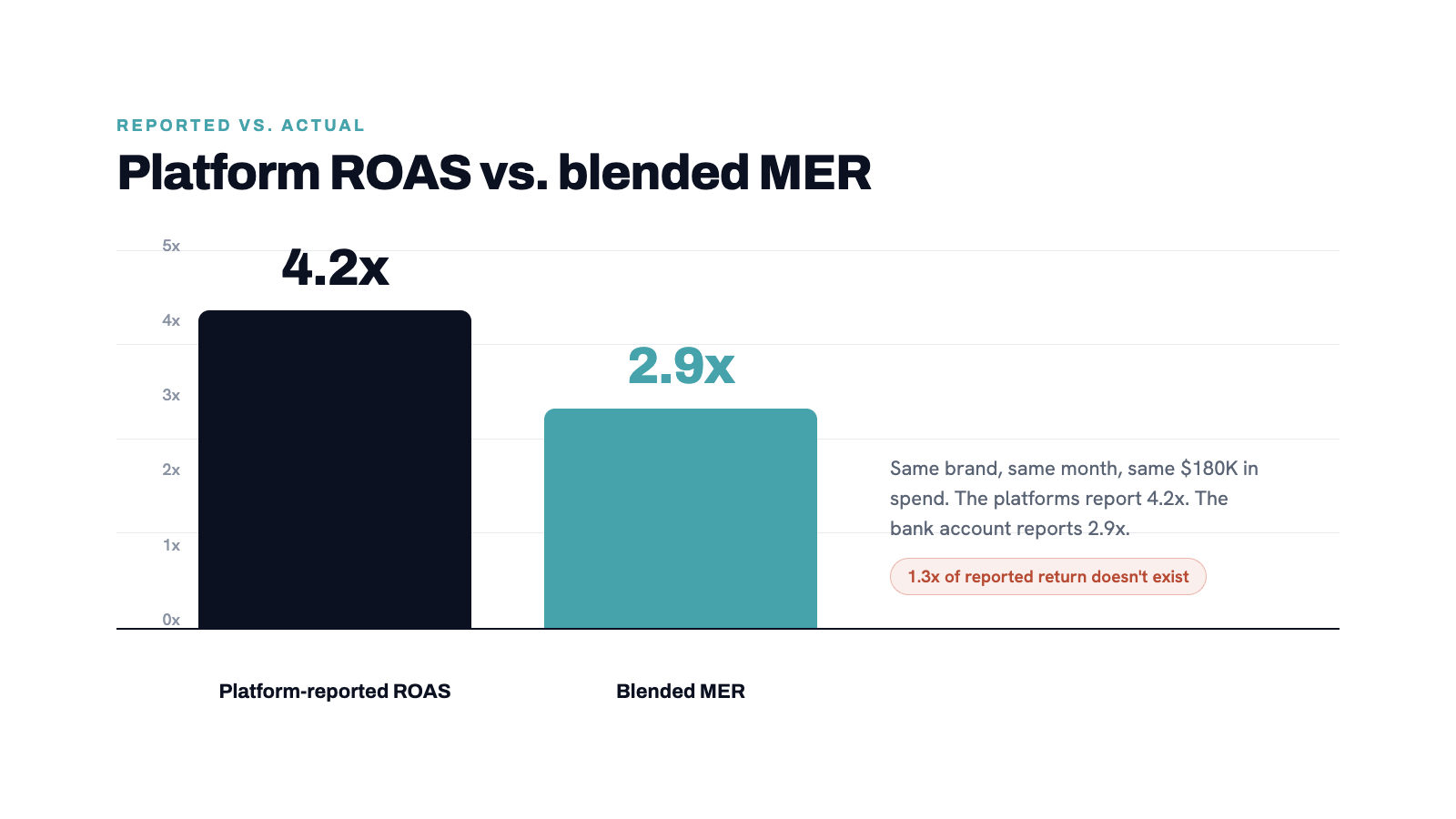
MER gives you three things platform ROAS can't:
A single source of truth across channels. Instead of three dashboards claiming three different versions of your revenue, you have one number that reflects what actually happened.
A real basis for scaling decisions. When your MER is healthy, you scale. When it compresses, you investigate. No more chasing a number that's partially invented.
An honest read on your full funnel. A high platform ROAS with a low MER usually means your ads are taking credit for revenue that email, organic, or repeat behavior actually drove. That's a retention problem, not a paid media win.
You don't need to abandon platform reporting entirely. ROAS is still useful as a directional signal - if one campaign's ROAS moves sharply relative to others, that's worth investigating. But it shouldn't be the number that drives budget decisions.
Here's a simple framework:
Use MER to decide whether to scale or hold. If your MER is at or above target, scale spend. If it's compressing, stop before you add more fuel to the fire.
Use platform ROAS to compare campaigns to each other. Within the same platform, ROAS comparisons are still meaningful. You're measuring them against the same methodology, so relative performance is valid even if absolute performance is overstated.
Track MER monthly, not daily. Day-to-day MER fluctuates too much to be useful. Monthly gives you a signal you can act on.
Here's where MER gets more interesting.
A brand with strong retention will always have a better MER than one without it - even at the same ad spend level. Why? Because email and SMS revenue, repeat purchase revenue, and organic revenue all count in the numerator. If your lifecycle program is working, your MER reflects it.
This is why we talk about paid and retention as one system, not two departments. The brands with the healthiest MER aren't the ones with the best media buyers. They're the ones where paid acquisition feeds into a retention engine that multiplies the return on every dollar spent.
When someone tells you their ROAS is 5x, the first question isn't "what's your creative strategy." It's "what's your repeat purchase rate."
Pull your numbers for last month:
1. Total revenue across all channels
2. Total marketing spend across all channels (ads, agency fees, tools)
3. Divide revenue by spend
That's your MER. Compare it to your platform-reported blended ROAS. The gap between those two numbers tells you something important about your attribution, your retention, and where your next growth dollar should actually go.
Lorem ipsum dolor sit amet, consectetur adipiscing elit. Suspendisse varius enim in eros elementum tristique. Duis cursus, mi quis viverra ornare, eros dolor interdum nulla, ut commodo diam libero vitae erat. Aenean faucibus nibh et justo cursus id rutrum lorem imperdiet. Nunc ut sem vitae risus tristique posuere.Full-Funnel Ecommerce Marketing: How to Connect Paid Ads and Email for Higher MER
Lorem ipsum dolor sit amet, consectetur adipiscing elit. Suspendisse varius enim in eros elementum tristique. Duis cursus, mi quis viverra ornare, eros dolor interdum nulla, ut commodo diam libero vitae erat. Aenean faucibus nibh et justo cursus id rutrum lorem imperdiet. Nunc ut sem vitae risus tristique posuere.Customer Retention vs Acquisition: Why DTC Brands Need Both to Scale Profitably
Want to know what your real MER is - and what's holding it back?
Our growth diagnostic is a full teardown of your acquisition economics and retention setup. Fixed scope, free for qualified brands.
Book your free growth diagnostic →