Full Funnel Strategy
There's a mental model that changes the way most founders think about their marketing budget the moment they hear it.
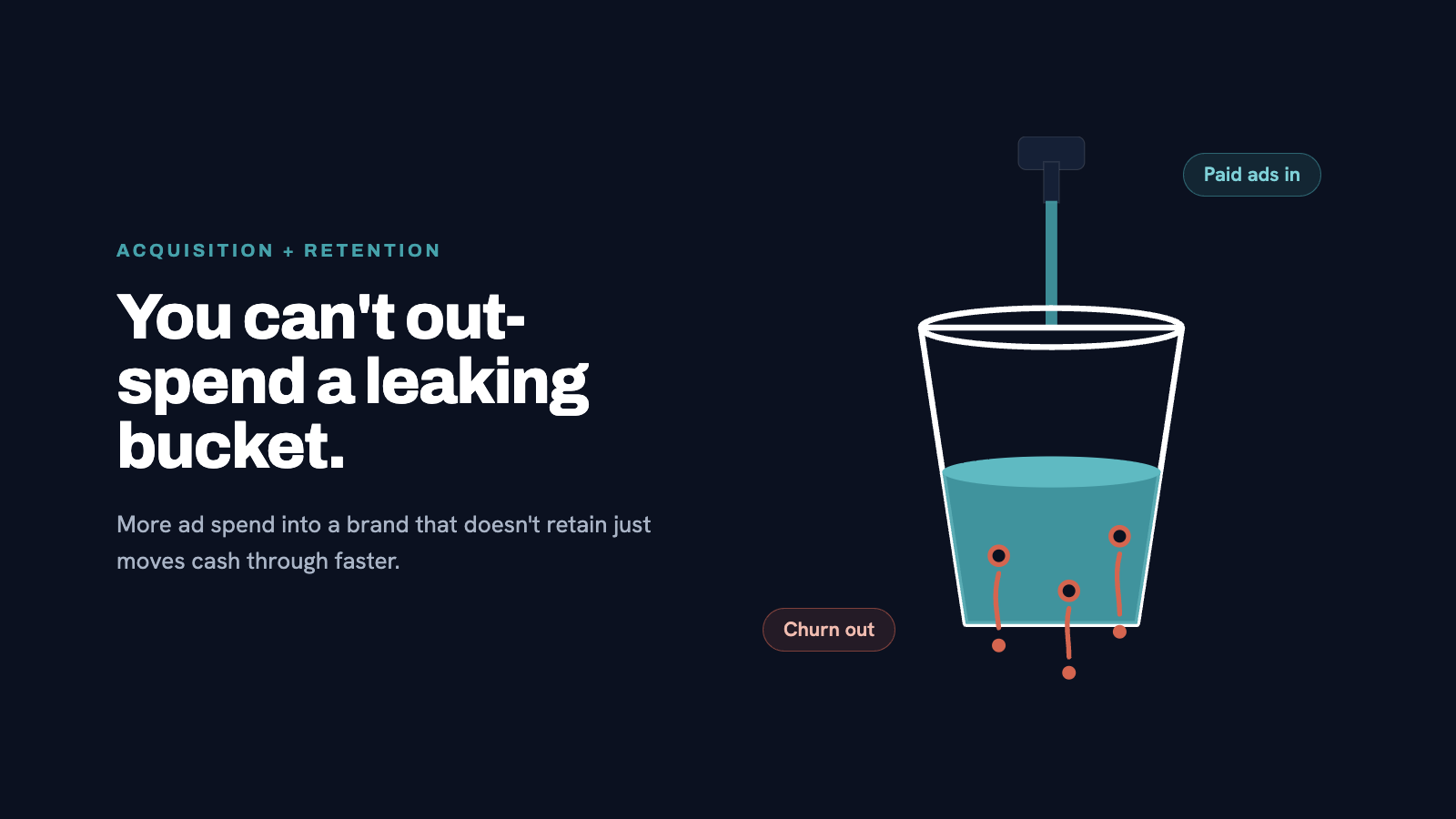
Picture your customer base as a bucket. Paid media is the tap - every dollar you spend pours more water in. Every new customer is another cup. Churn is the set of holes in the bottom, and water leaks out of them whether you're watching or not.
Here's the part most founders miss: if the bucket leaks faster than you pour, spending more on the tap doesn't fill the bucket. It just runs more water through the holes. Faster. At a higher cost.
The number that tells you whether your acquisition is actually working isn't ROAS. It's payback period - how long it takes a customer to generate enough contribution margin to cover what you paid to acquire them.
If your CAC is $40 and a customer contributes $20 of margin per order, you break even on the second order. Whether a customer reaches that second order is a retention question, not an acquisition question. Your media buyer got them through the door. Your lifecycle program decides whether they come back before the math turns positive.
This is why ROAS on its own lies to you. A 3x first-purchase ROAS looks healthy. If most of those buyers never order again, and your margin needs more than two orders to clear CAC, you just scaled a loss. The ad account looked like the hero. The bucket was the real story.
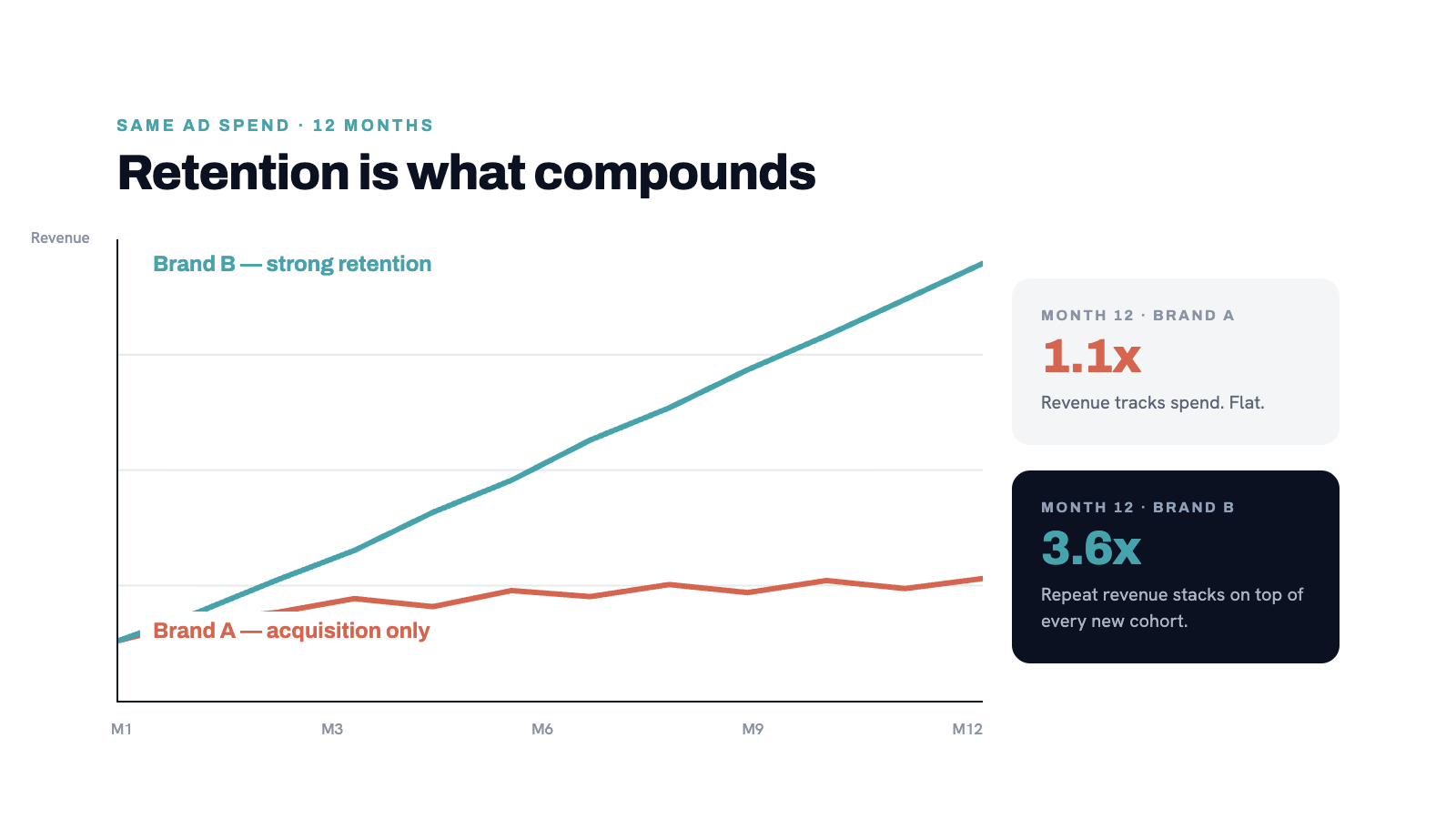
When acquisition and lifecycle live in separate systems, the leaks show up in four predictable places.
Double-counted conversions. Your ad platform claims a sale on last click. Your email tool claims the same sale on last touch. Add the two dashboards together and you've attributed 140% of your revenue. Budget decisions get made on inflated numbers, and you over-fund whichever channel reports most aggressively.
The payback gap. Acquisition is measured on cost per purchase. Nobody owns the window between first purchase and payback. Customers churn inside that window, and because no single dashboard spans it, the loss never registers as a loss. It shows up as "CAC crept up," and the ad account takes the blame.
Reactivation that fires too late. Lifecycle flows are usually built off email behavior, not acquisition signals. A high-value customer who bought through a specific campaign and is showing early churn signals gets the same generic winback as everyone else - weeks after the moment to save them had passed.
A promise the product never keeps. The ad sells one thing. The post-purchase emails say something else, or nothing. First-time buyers arrive with an expectation that onboarding never reinforces, so they never form the habit that becomes a second order.
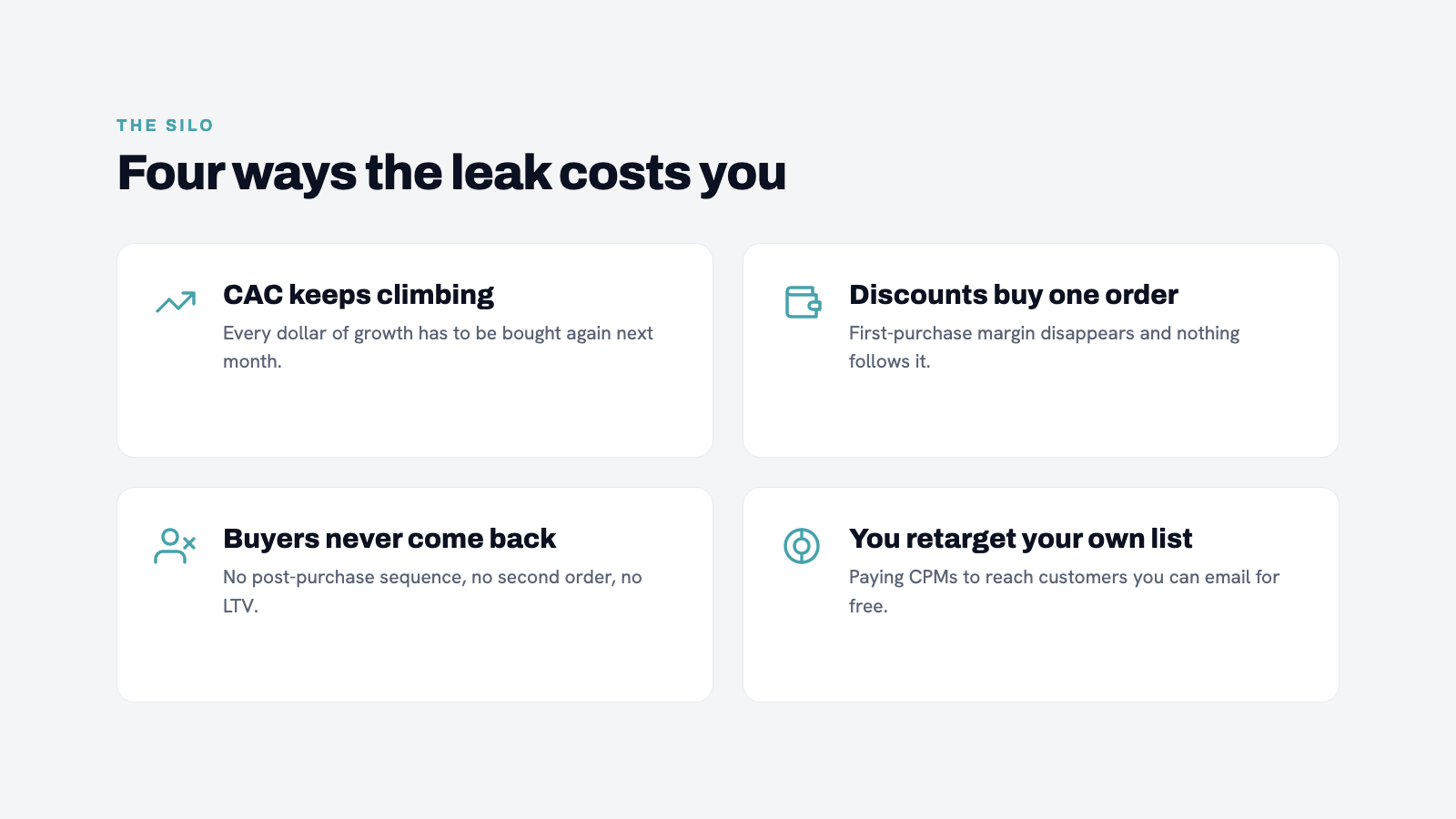
Two brands. Same category, same product, same ad spend, same first-purchase economics. The only thing that differs is what happens after the first order.
Metric
Brand A
Brand B
Monthly ad spend
$50,000
$50,000
CAC
$40
$40
New customers / month
1,250
1,250
12-month repeat rate
25%
45%
12-month LTV (margin)
$30.80
$50.60
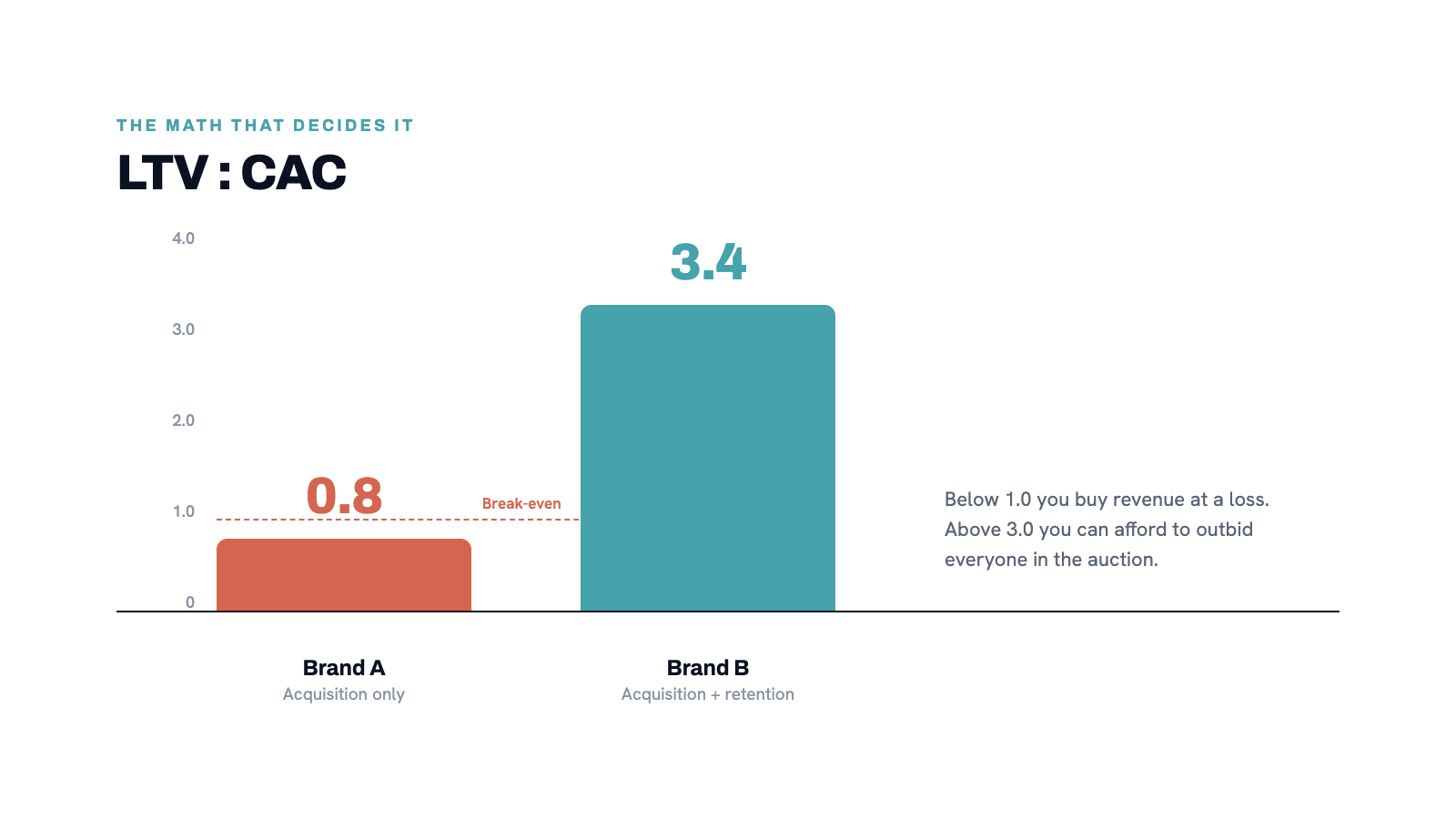
LTV:CAC
0.77:1
1.27:1
Payback
Never clears
~1.8 orders
Brand A and Brand B run identical ad accounts. Brand A is unprofitable on a fully loaded basis and doesn't know it, because the first-purchase ROAS reads fine. Brand B clears payback, can afford to bid higher, and wins impressions Brand A cannot.
What changed? Not the media. Not the offer. Not the CAC. The repeat rate moved from 25% to 45%, and that single lever flipped one business from bleeding money to compounding it.
Putting paid media and lifecycle under one roof isn't about headcount or org charts. It comes down to four operating changes.
One source of truth for attribution. You stop adding up platform dashboards and start measuring blended performance: total revenue against total spend, plus cohort payback. Every budget decision references the same number.
Lifecycle triggered off acquisition data. The email and SMS program knows which campaign and offer brought each customer in, and tailors onboarding to match the promise that acquired them. Winback fires on early churn signals, not on a fixed calendar.
Budgets set on payback-adjusted value. You scale spend against what a cohort is actually worth after accounting for the holes in the bucket - not against last-click ROAS.
One message, first impression to fifth order. The hook in the ad, the landing page, the first email, and the third all reinforce the same promise. The customer hears one consistent story, which is exactly what builds the habit that produces repeat orders.
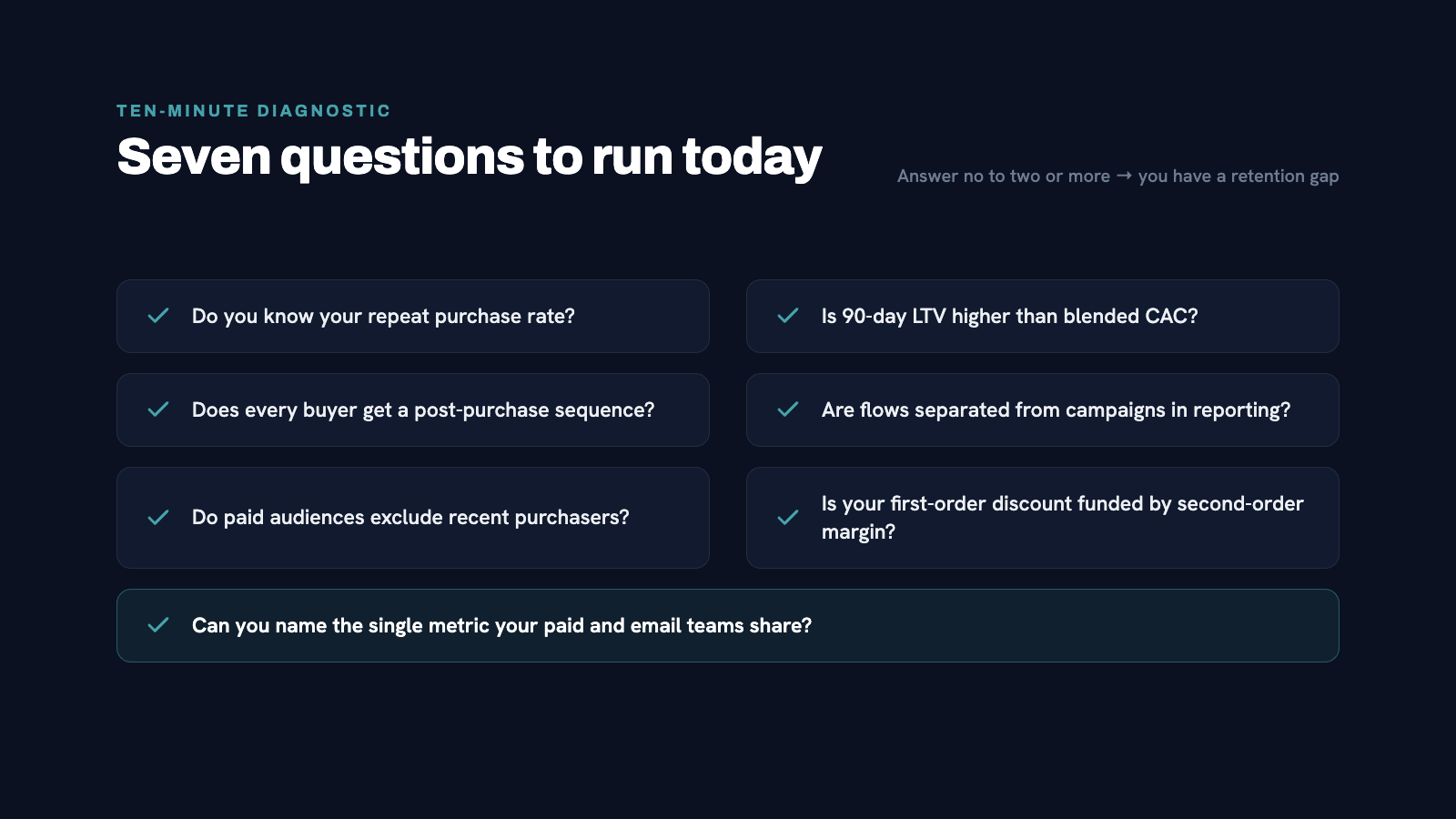
Answer each of these honestly:
• Do you know your contribution margin per order, after COGS, shipping, payment fees, and discounts?
• Do you know your payback period in number of orders?
• Can you state last month's blended MER without opening two dashboards and adding them up?
• Does your email and SMS program know which campaign acquired each customer?
• Does your winback trigger on behavior that predicts churn, or on a fixed number of days?
• Do your top ad hooks and your first three post-purchase emails make the same promise?
• If you doubled ad spend tomorrow, do you know whether your retention could support it?
If you answered no to three or more, you don't have an acquisition problem or a retention problem. You have a coordination problem - and it's quietly costing you margin on every single order.
Most agencies are built to make one half of this work. A media shop will lower your CAC and hand the customer off into a void. A retention shop will build beautiful flows for traffic that costs too much to acquire. Both can show you a dashboard that looks like progress while the bucket keeps draining.
Running both halves as one connected system is the difference between a business that scales and one that spins its wheels with a growing ad budget.
Lorem ipsum dolor sit amet, consectetur adipiscing elit. Suspendisse varius enim in eros elementum tristique. Duis cursus, mi quis viverra ornare, eros dolor interdum nulla, ut commodo diam libero vitae erat. Aenean faucibus nibh et justo cursus id rutrum lorem imperdiet. Nunc ut sem vitae risus tristique posuere.Ecommerce Email Flows: The 7 Automations Every DTC Brand Needs (2026 Guide)
Lorem ipsum dolor sit amet, consectetur adipiscing elit. Suspendisse varius enim in eros elementum tristique. Duis cursus, mi quis viverra ornare, eros dolor interdum nulla, ut commodo diam libero vitae erat. Aenean faucibus nibh et justo cursus id rutrum lorem imperdiet. Nunc ut sem vitae risus tristique posuere.Post-Purchase Email Sequence for Ecommerce: How to Increase Repeat Purchase Rate
Want the full breakdown with the math applied to your numbers?
Download the free Leaky Bucket guide - or book a growth diagnostic and we'll run it on your real data.
Download the free guide →