Email and SMS
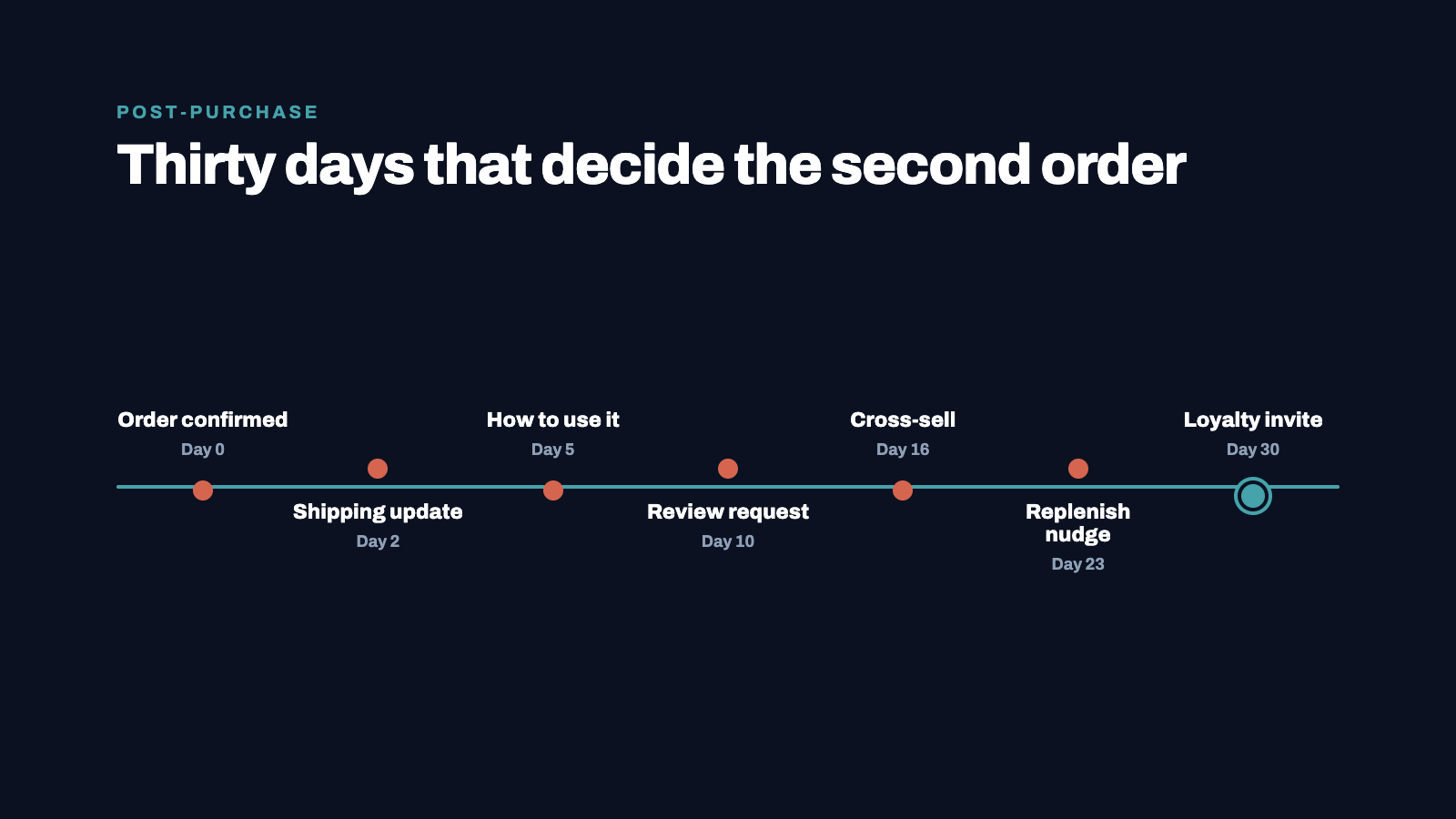
A post-purchase email sequence for ecommerce is the automated program that runs from the moment of first purchase through the 30-day repeat purchase window. Every DTC brand has a post-purchase email. It's the order confirmation that Shopify sends automatically and most brands never touch. It has the order number, a list of items, and a customer service email.
That's not a post-purchase sequence. That's a receipt.
The post-purchase sequence is the deliberate program that runs from the moment of purchase through the first 30 days of the customer relationship. It's not about confirming the transaction. It's about earning the next one.
A first-time buyer who doesn't make a second purchase within 30 to 60 days has less than a 15% chance of becoming a long-term customer.
That's not a strategy problem. It's a timing problem. The window to build the habit that becomes repeat purchase behavior opens right after the first order and closes fast. What you put in that window determines whether the customer returns or disappears.
Most brands put nothing in that window. A receipt, a shipping update, and then a promotional blast two weeks later with no connection to the purchase that started the relationship.
The post-purchase sequence changes that.
A post-purchase email sequence is a series of automated emails triggered by a first purchase, designed to validate the buying decision, educate the customer on the product, capture reviews at the right moment, and earn the second order before the customer goes quiet. It is distinct from the order confirmation email - which is a transactional receipt - and from the welcome flow, which is for subscribers who haven't bought yet.
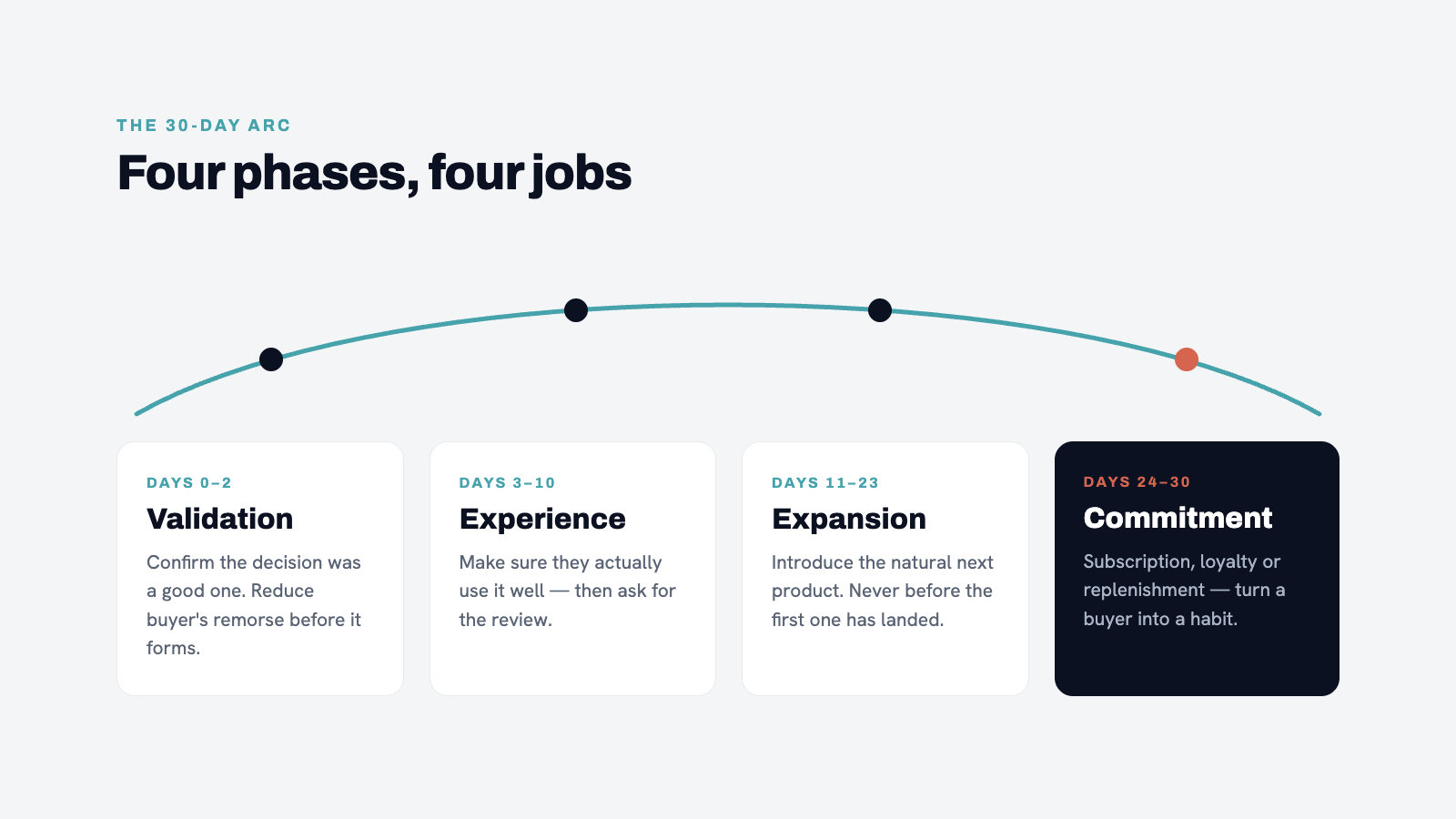
Every customer moves through a predictable arc after their first purchase. The sequence maps to it.
Days 0-7: Validation. The customer is in post-purchase doubt territory. The package hasn't arrived. The product isn't in their hands yet. All they have is the memory of the ad, the checkout page, and whatever arrives in their inbox first. This phase is about making them feel the purchase was the right call.
Days 8-14: Experience. The product has arrived. The customer is using it, or deciding whether to. This phase is about product education and satisfaction capture. A review request that fires when a customer is actively using the product outperforms one that fires on a fixed calendar date by a significant margin.
Days 15-21: Expansion. The customer has formed an initial opinion. If the experience was positive, this is the highest-leverage moment to introduce complementary products, a subscription option, or a loyalty program.
Days 22-30: Commitment. This is the window before the customer goes quiet. A buyer who hasn't made a second purchase by day 30 is statistically unlikely to make one without a specific reason. This phase delivers that reason.
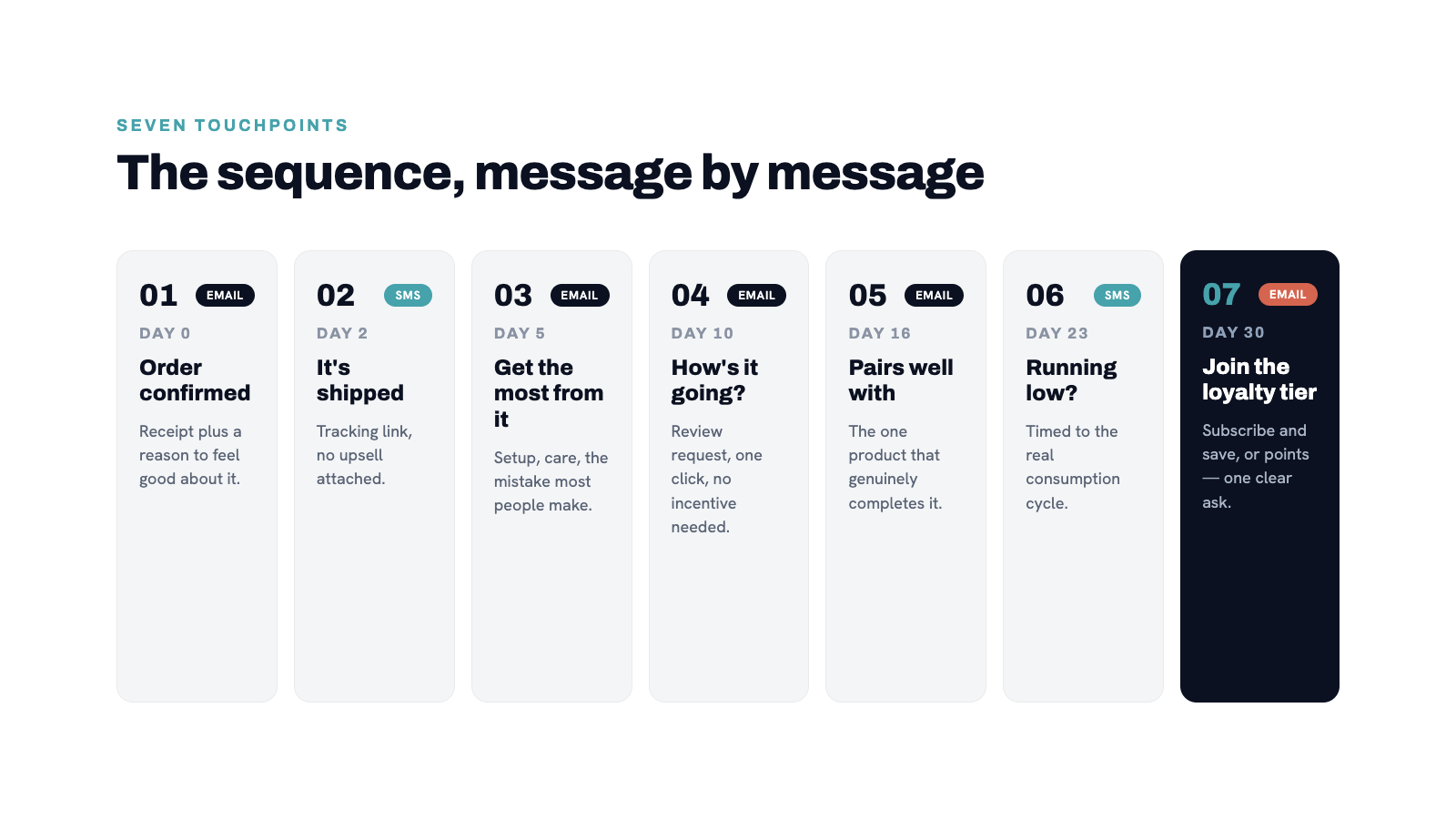
Here's what the full sequence contains:
Message 1 - Immediately - Brand confirmation. Not the Shopify receipt. A message from your brand voice that acknowledges the specific product, reinforces the promise that closed the sale, and makes the customer feel like they joined something, not just bought something.
Message 2 - Day 2-3 - Shipping update + anticipation. Logistics update combined with a piece of social proof specific to the product they ordered. A review that mirrors their likely use case. Something that builds anticipation for the arrival.
Message 3 - Day 5-7 - Arrival support. Timed to coincide with estimated delivery. How to use it, what to expect, what a great first experience looks like. This is also where you plant the seed for the review request.
Message 4 - Day 9-11 - Review request. Specific, not generic. Reference the product. Make submission frictionless. A product-specific review prompt outperforms a generic one by two to three times.
Message 5 - Day 14-16 - Brand deepening. Not a promotion. A reason to stay connected - a behind-the-scenes piece, the origin story of the product they bought, a community or loyalty program introduction.
Message 6 - Day 18-21 - Product expansion. A specific, relevant product recommendation. Not a homepage link - a single product that complements what they bought, with a clear reason it pairs well.
Message 7 - Day 27-30 - Commitment close. For customers who haven't made a second purchase: a specific, time-sensitive reason to do so. For consumable products: a refill reminder. For others: strong social proof on the product they bought, paired with the next most relevant recommendation.
Connecting to the acquisition signal. The post-purchase sequence that knows which campaign and creative angle brought each customer in - and references it - outperforms the generic version. The first email that says "we're glad you found us through our summer sale" is more powerful than one that ignores the context entirely. This only happens when your ad platform and your email tool share data.
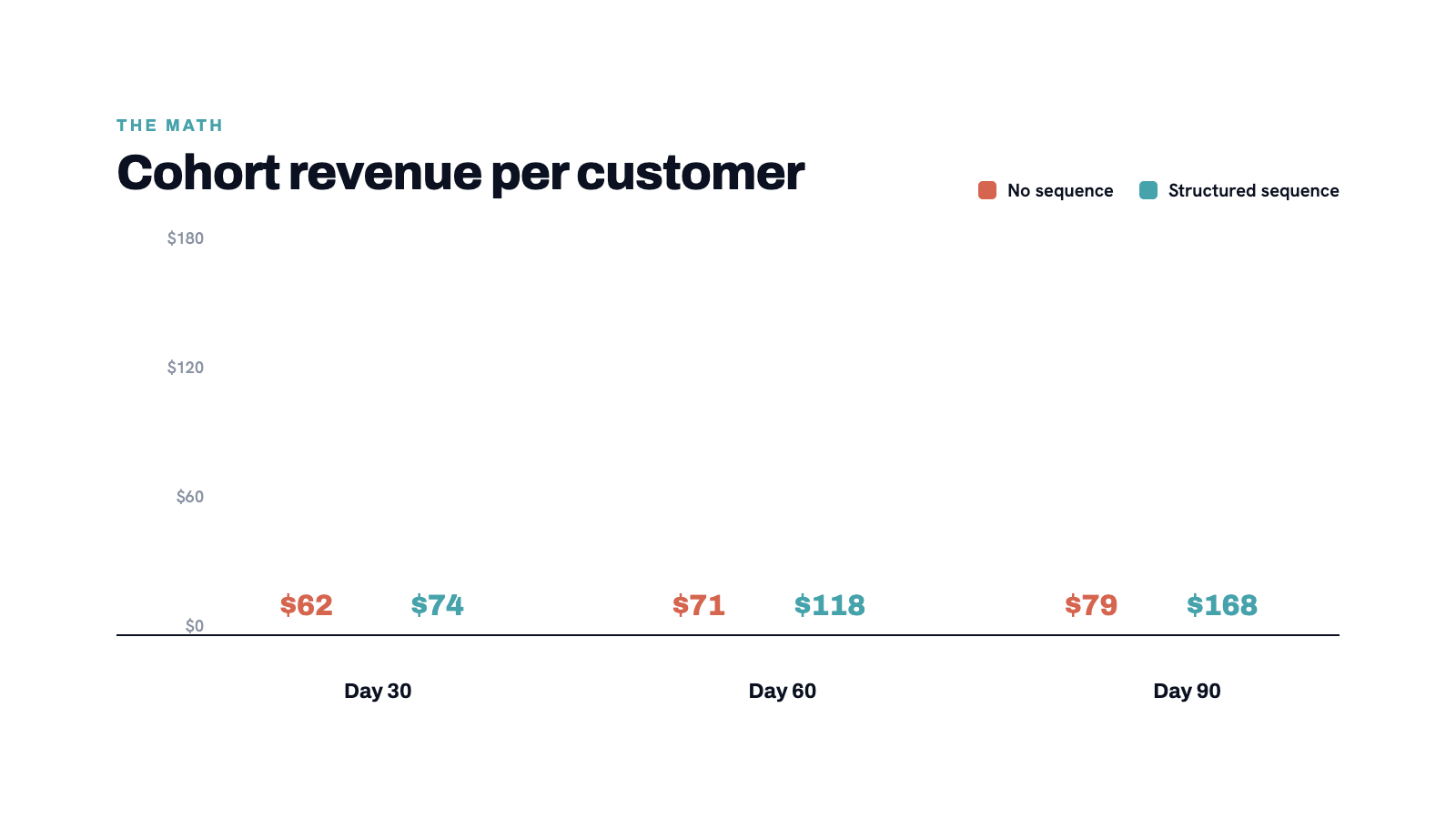
Measuring payback, not open rate. The success metric for a post-purchase sequence is not email engagement. It's the 30-day repeat purchase rate of customers who went through the sequence versus those who didn't. Open rates tell you if the subject line worked. Payback tells you if the sequence worked.
Illustrative 90-day cohort of 1,000 first-time buyers. CAC: $45. AOV: $62. Contribution margin: $24 per order.
No sequence
Structured sequence
30-day repeat rate
19%
34%
90-day repeat rate
33%
55%
Avg orders / customer (90 days)
1.4
2.1
Contribution margin / customer
$33.60
$50.40
Cohort revenue (1,000 customers)
$33,600
$50,400
The structured sequence generates $16,800 more contribution margin from the same 1,000 customers - without acquiring a single new one. At a $45 CAC, that is the equivalent of 373 new customers, free.
How many emails should be in a post-purchase sequence?
A working post-purchase sequence has a minimum of five emails over 30 days: a brand confirmation immediately after purchase, a shipping plus anticipation email around days two to three, an arrival support email at days five to seven, a review request at days nine to eleven, and a second-purchase prompt at days eighteen to twenty-one. Seven emails over 30 days is a complete sequence.
When should post-purchase emails be sent?
The most important timing is the first email - it should send within minutes of purchase, not hours. The sequence then runs over 30 days, with messages timed to product delivery and the customer's likely usage pattern.
What should a post-purchase email sequence include?
A complete sequence includes brand confirmation, shipping updates with anticipation-building content, product education or usage guides, a review request timed to when the customer has actually used the product, a complementary product recommendation, and a second-purchase prompt with a specific reason to return.
How does a post-purchase sequence increase repeat purchase rate?
By maintaining contact during the highest-engagement window after a purchase, reinforcing the purchase decision, educating on product use to reduce buyer's remorse, and presenting a specific reason to return at the moment the customer is most likely to buy again.
Lorem ipsum dolor sit amet, consectetur adipiscing elit. Suspendisse varius enim in eros elementum tristique. Duis cursus, mi quis viverra ornare, eros dolor interdum nulla, ut commodo diam libero vitae erat. Aenean faucibus nibh et justo cursus id rutrum lorem imperdiet. Nunc ut sem vitae risus tristique posuere.Ecommerce Email Flows: The 7 Automations Every DTC Brand Needs (2026 Guide)
Lorem ipsum dolor sit amet, consectetur adipiscing elit. Suspendisse varius enim in eros elementum tristique. Duis cursus, mi quis viverra ornare, eros dolor interdum nulla, ut commodo diam libero vitae erat. Aenean faucibus nibh et justo cursus id rutrum lorem imperdiet. Nunc ut sem vitae risus tristique posuere.Email Welcome Flow for Ecommerce: How to Convert Subscribers into First-Time Buyers
The 30-day window is already running for every customer you acquired this month.
Download the Post-Purchase Sequence guide - or book a diagnostic and we'll look at what's running in your account right now.
Download the free guide →