Email and SMS
Most DTC brands that use both email and SMS use them the same way. They write a campaign, send it to email, then send a shorter version to SMS. The subscriber receives the same message twice in the same 24-hour window from two different channels.
That's not a multichannel strategy. That's redundancy with extra steps.
Email and SMS are not the same channel with different delivery methods. They behave differently, they get different levels of attention, and they should be doing different jobs in your lifecycle program.
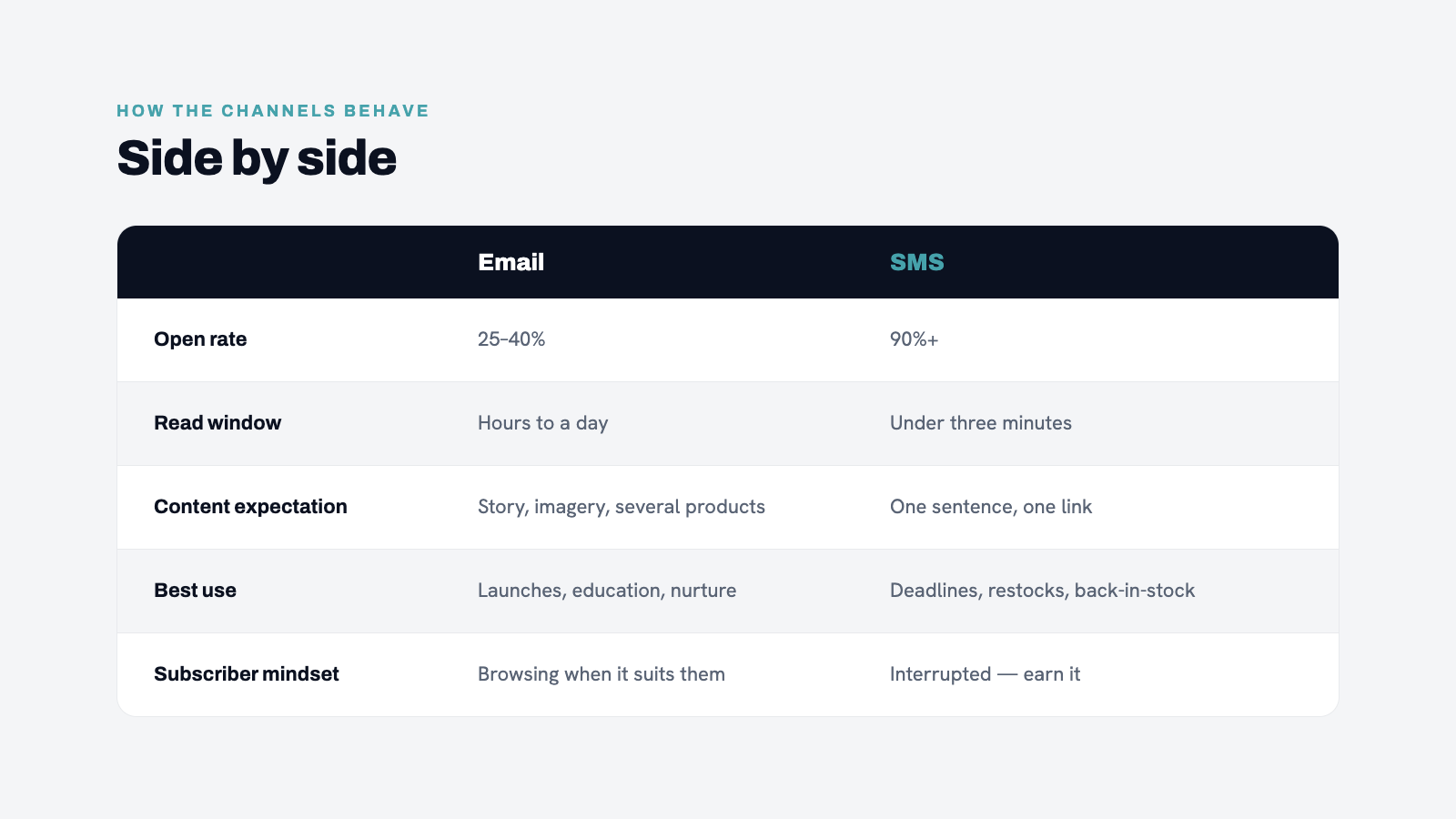
Email has a longer attention window. Subscribers expect more content, more context, and more design. Open rates average 40-65% for DTC brands with healthy lists. The window to be read can span 24-48 hours after send. It's the right channel for brand storytelling, product education, social proof, and complex offers.
SMS is immediate. It gets read in minutes - often seconds. Open rates are above 90% for compliant programs. Subscribers expect short, direct, action-oriented messages. The window to be acted on is narrow. It's the right channel for urgency, time-sensitive offers, shipping updates, and nudges.
The distinction matters because once you understand what each channel is actually good at, you stop competing with yourself.
Here's the framework for splitting channel responsibilities:
Email does the work:
• Brand storytelling and positioning
• Product education and how-to content
• Social proof (reviews, UGC, press)
• Complex offers with multiple options
• Winback sequences with context and nuance
• Post-purchase sequences with detailed content
• Newsletter content and value delivery
SMS does the nudging:
• Time-sensitive sale notifications ("ends tonight")
• Abandoned cart or checkout reminders after email hasn't converted
• Back-in-stock alerts on high-demand items
• Shipping and delivery updates
• Event reminders (webinars, launches, live sales)
• VIP early access notifications
• Re-engagement pings after email goes unopened
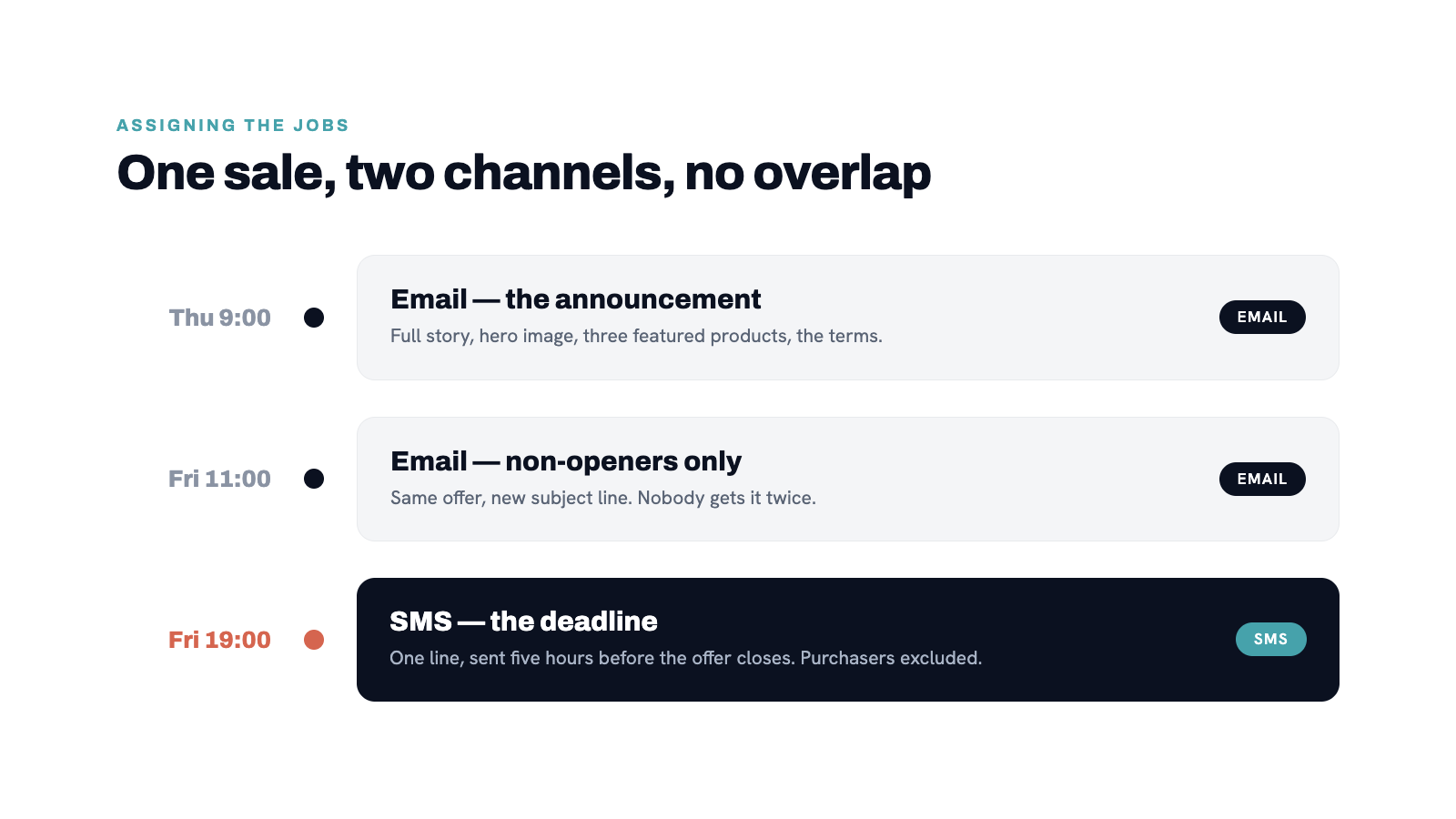
The most effective multichannel programs use email and SMS in sequence rather than simultaneously. A few principles:
Email first, SMS if unopened. For a time-sensitive campaign, send the email first. If the subscriber doesn't open in 12-24 hours, trigger an SMS. This uses SMS precisely where it adds value - rescuing the send - rather than duplicating content.
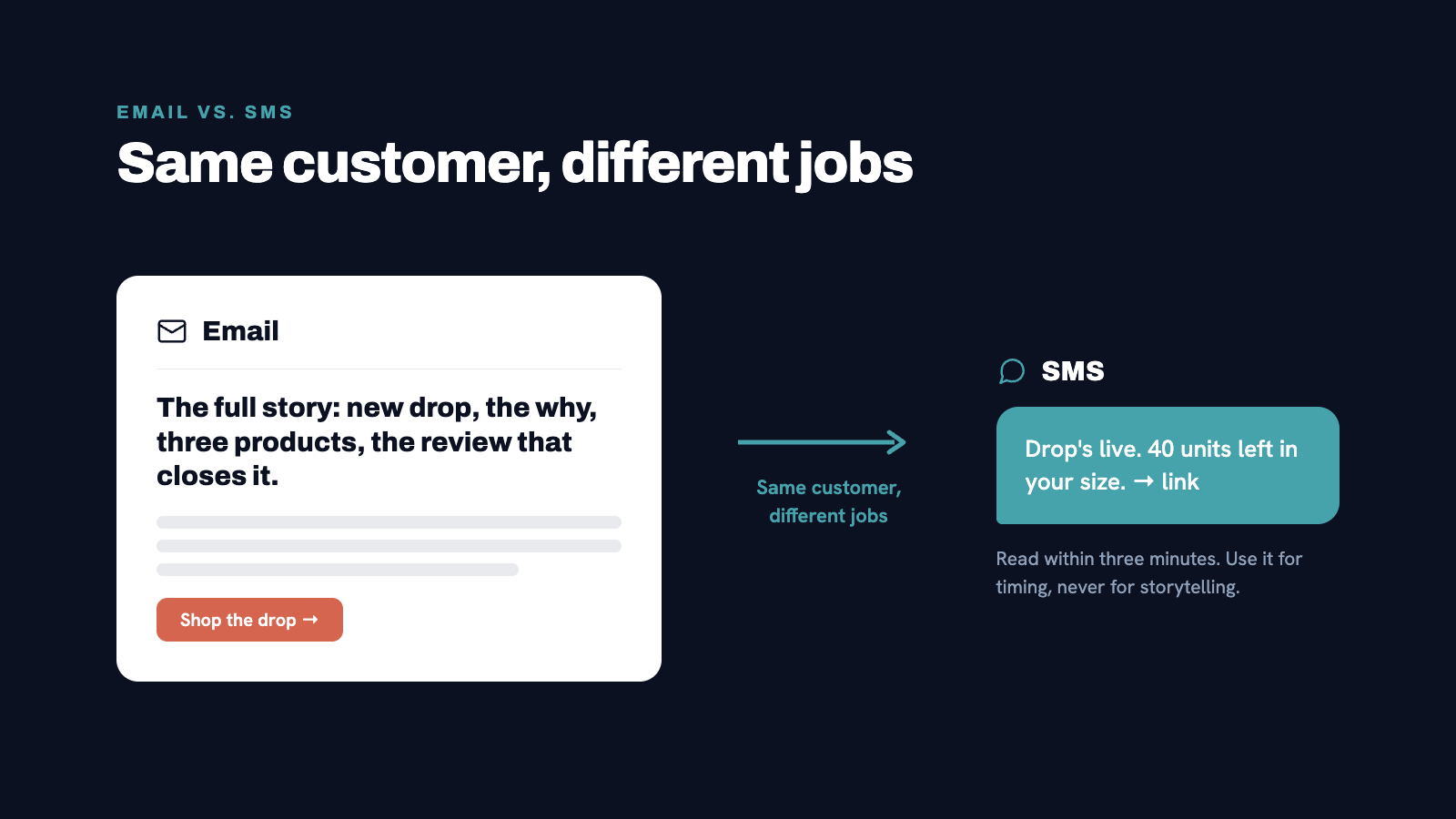
SMS for the moment, email for the context. When a new product drops or a sale goes live, SMS announces it in one line. Email tells the story - the why, the social proof, the full product details. Different jobs, different timing.
Don't send both at the same time. A subscriber getting an email and an SMS within the same hour feels spammed, not served. Stagger them intentionally.
Let behavior determine channel. If a subscriber consistently opens email but never clicks SMS links, route them to email-heavy sequences. If they're clicking SMS but ignoring email, the opposite. Treat channel preference as behavioral data.
One thing worth flagging: your SMS list and your email list are not the same people in equal proportions. SMS requires explicit consent and tends to be a smaller, more engaged subset of your total subscribers.
This means SMS programs punch above their weight on revenue per message - but only if you treat it like the high-permission, high-trust channel it is. Sending SMS at email frequency trains subscribers to opt out. Sending it only when there's a genuine reason to reach them immediately keeps the channel valuable.
A healthy SMS program for a DTC brand typically sends two to four times per month - fewer, more intentional messages with higher per-send impact.
Some brands reading this have an email program and no SMS at all. For a DTC brand with strong open rates and an engaged list, zero SMS revenue is almost always a missed opportunity - especially for time-sensitive events like flash sales, back-in-stock, and BFCM.
Building an SMS list from zero takes time, but the starting point is simple: add an SMS opt-in step to your existing email popup, run a dedicated SMS opt-in campaign to your most engaged email subscribers, and build the first three flows (welcome, abandon checkout, VIP) before sending any campaigns.
Lorem ipsum dolor sit amet, consectetur adipiscing elit. Suspendisse varius enim in eros elementum tristique. Duis cursus, mi quis viverra ornare, eros dolor interdum nulla, ut commodo diam libero vitae erat. Aenean faucibus nibh et justo cursus id rutrum lorem imperdiet. Nunc ut sem vitae risus tristique posuere.Ecommerce Email Flows: The 7 Automations Every DTC Brand Needs (2026 Guide)
Lorem ipsum dolor sit amet, consectetur adipiscing elit. Suspendisse varius enim in eros elementum tristique. Duis cursus, mi quis viverra ornare, eros dolor interdum nulla, ut commodo diam libero vitae erat. Aenean faucibus nibh et justo cursus id rutrum lorem imperdiet. Nunc ut sem vitae risus tristique posuere.Email Welcome Flow for Ecommerce: How to Convert Subscribers into First-Time Buyers
Not sure how your paid and email channels are working together - or if they are at all?
Our growth diagnostic covers both sides. Free for qualified brands.
Book your free growth diagnostic →