Email and SMS
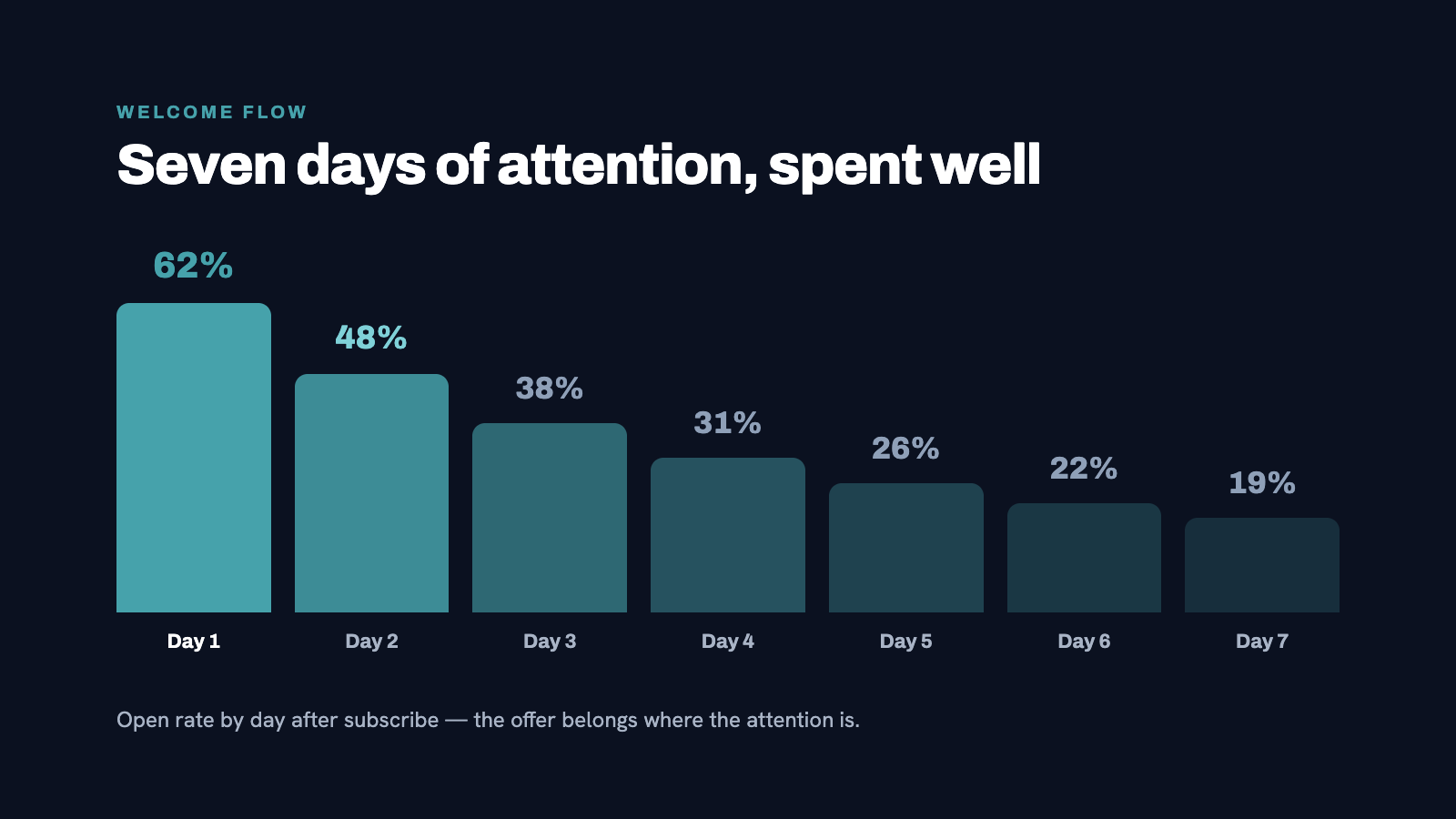
An email welcome flow for ecommerce is the automated sequence that fires when someone joins your list - the highest-attention, highest-intent window in the entire customer relationship. Someone gave you their email address or phone number. They have not bought yet. They are, right now, at the highest point of attention and intent they will ever have with your brand.
What happens in the next seven days will determine whether they become a customer or a name on a list you're paying to store.
Most brands waste this window completely.
A visitor lands on your site. They see a popup - 10% off their first order, or early access, or just "join the list." They enter their email or phone number. And then, in most cases, they receive a welcome email that reads like it was written by the platform's default template, followed by two more emails, and then silence or promotions.
The opt-in is a signal, not a sale. It means the visitor was interested enough to give you their contact information. It does not mean they are ready to buy. The welcome flow is the program that converts that interest into a first purchase - and it has a narrow window to do it before attention fades and the opt-in becomes just another address on a list.
Most brands treat the welcome flow as a formality. The brands that grow treat it as their highest-converting sequence.
Three things are happening simultaneously in the first 48 hours after an opt-in:
Attention is at its highest. A new subscriber will open your first email at two to four times the rate they open your fifth. That open rate never comes back. Whatever you put in front of them in the first 24 hours is the highest-leverage real estate in your entire email program.
Intent is actively decaying. The visitor who signed up because they were looking at a specific product is thinking about that product right now. In 48 hours they will be thinking about something else. In a week the original trigger is gone.
Trust is being established - or not. A subscriber who receives a generic welcome sequence learns something about your brand: that you are not paying attention. A subscriber who receives a specific, relevant, well-timed sequence learns something different.
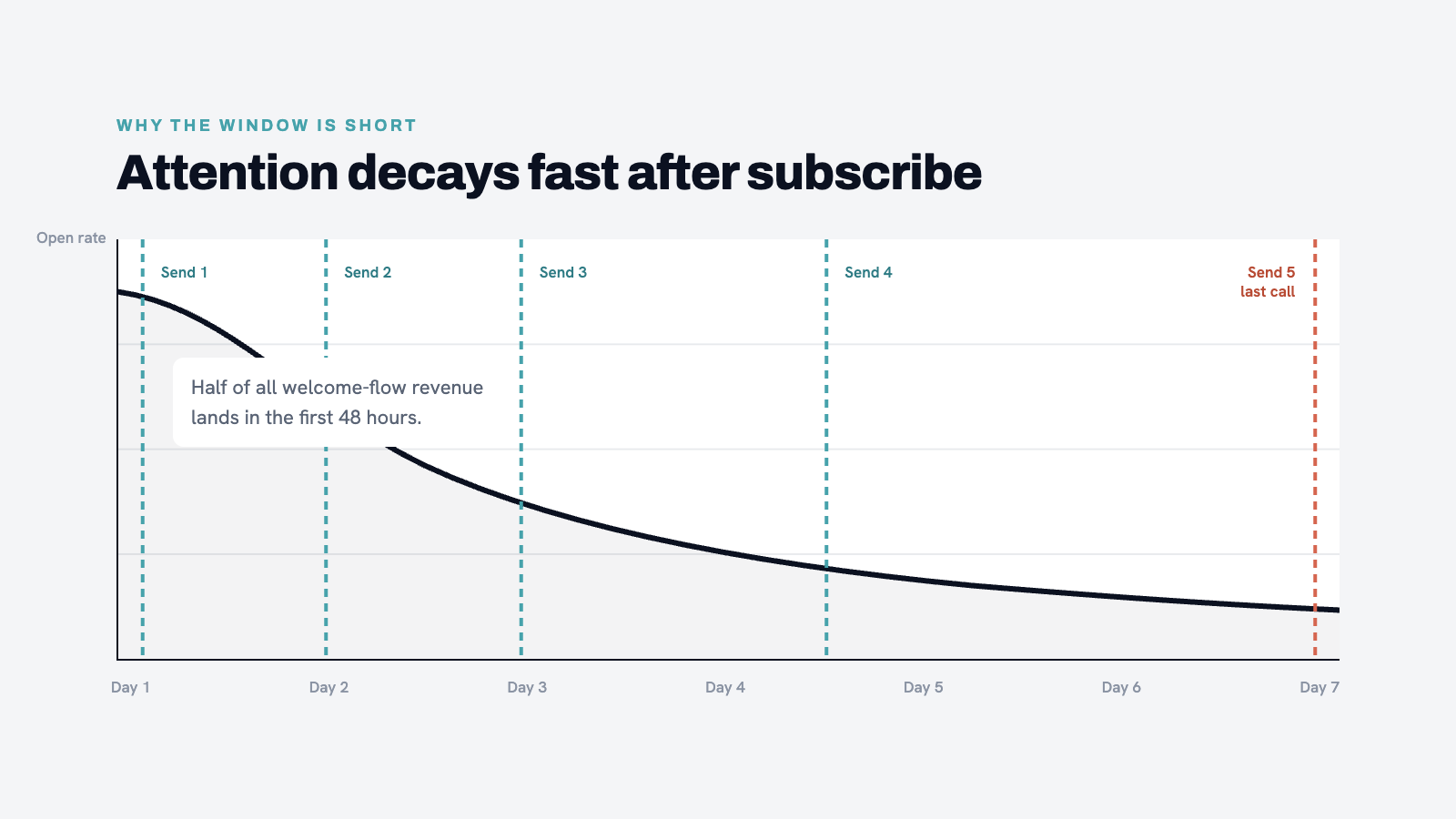
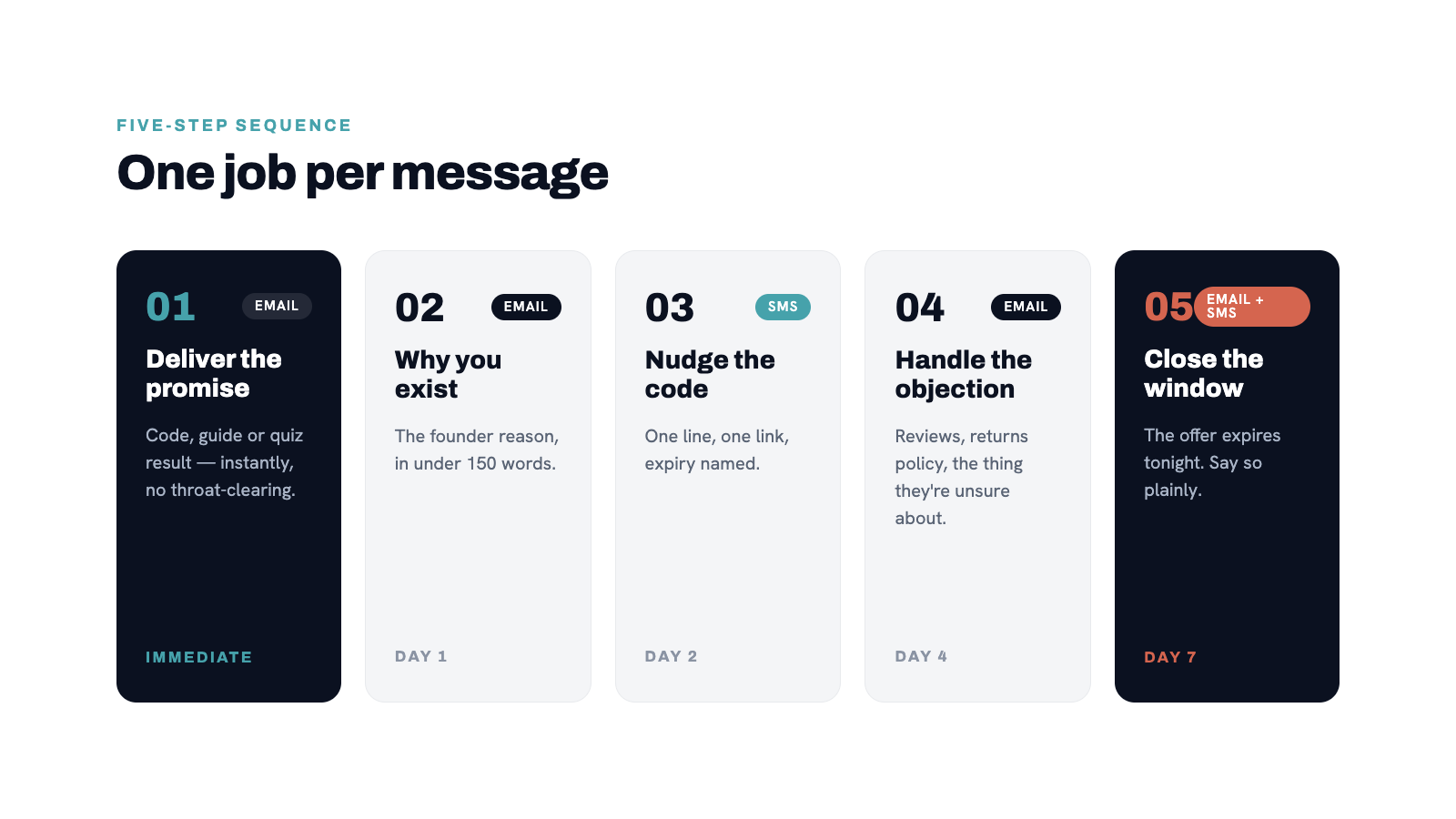
Every message in a working welcome flow has a specific job. Here's the structure:
Message 1 - Immediately - Email + SMS Deliver the offer. If they signed up for a discount, give it immediately and clearly. One sentence of brand positioning. One CTA: shop now. Subject line should be direct: "Your 10% off is here" outperforms "Welcome to the family" every time.
Message 2 - Day 1 - Email Brand story and differentiation. The subscriber knows the offer exists. Now earn their preference. What makes your product different from the alternatives? One strong differentiator, told with specificity, beats a list of five.
Message 3 - Day 3 - Email Social proof targeted to the most common objection. What stops a new subscriber from converting? Address the single most common barrier with your strongest proof - a specific customer review, a media mention, a before-and-after result.
Message 4 - Day 5 - Email + SMS Urgency on the original offer. If the discount hasn't been used, create a genuine reason to act now. "Your offer expires in 48 hours" is fine. Something specific and true is better.
Message 5 - Day 7 - Email The fallback and segmentation point. For subscribers who haven't converted after seven days, either make a final offer or ask a preference question that segments them for future sends.
Personalization based on how they arrived. A subscriber who came in through a paid ad for a specific product should receive a welcome flow that references that product. When your ad platform and your email tool share data, the welcome flow knows where each subscriber came from and adjusts accordingly. Generic welcome flows treat every subscriber as if they arrived the same way. They did not.
A defined path for non-converters. A subscriber who doesn't convert in the first seven days is not a failed welcome flow - they're a longer-consideration buyer. The working welcome flow identifies them at day seven and routes them into a separate track. The list of non-converters from your welcome flow is one of the highest-intent segments you own. Don't let them fall into the general newsletter list and disappear.
Pull up your welcome flow and answer these:
• Does your first email send within five minutes of the opt-in?
• Does message one deliver the opt-in incentive clearly, with a single direct CTA?
• Do you have a message specifically dedicated to brand differentiation?
• Do you have a social proof message that addresses your most common pre-purchase objection?
• Does your sequence include genuine urgency before the offer expires?
• Are you using SMS at any point in the welcome sequence?
• Does your flow do anything different for subscribers who came through a paid ad?
• Do you have a defined next step for subscribers who reach the end without converting?
Four or more nos means your welcome window is leaking.
Lorem ipsum dolor sit amet, consectetur adipiscing elit. Suspendisse varius enim in eros elementum tristique. Duis cursus, mi quis viverra ornare, eros dolor interdum nulla, ut commodo diam libero vitae erat. Aenean faucibus nibh et justo cursus id rutrum lorem imperdiet. Nunc ut sem vitae risus tristique posuere.Ecommerce Email Flows: The 7 Automations Every DTC Brand Needs (2026 Guide)
Lorem ipsum dolor sit amet, consectetur adipiscing elit. Suspendisse varius enim in eros elementum tristique. Duis cursus, mi quis viverra ornare, eros dolor interdum nulla, ut commodo diam libero vitae erat. Aenean faucibus nibh et justo cursus id rutrum lorem imperdiet. Nunc ut sem vitae risus tristique posuere.How to Grow an Ecommerce Email List That Converts: DTC List Building Guide (2026)
Get the complete welcome flow breakdown - free.
The Welcome Window guide covers the framework, the sequence, the timing, and the math - plus a diagnostic you can run on your current flow in ten minutes.
Download the Welcome Window guide →