Email and SMS
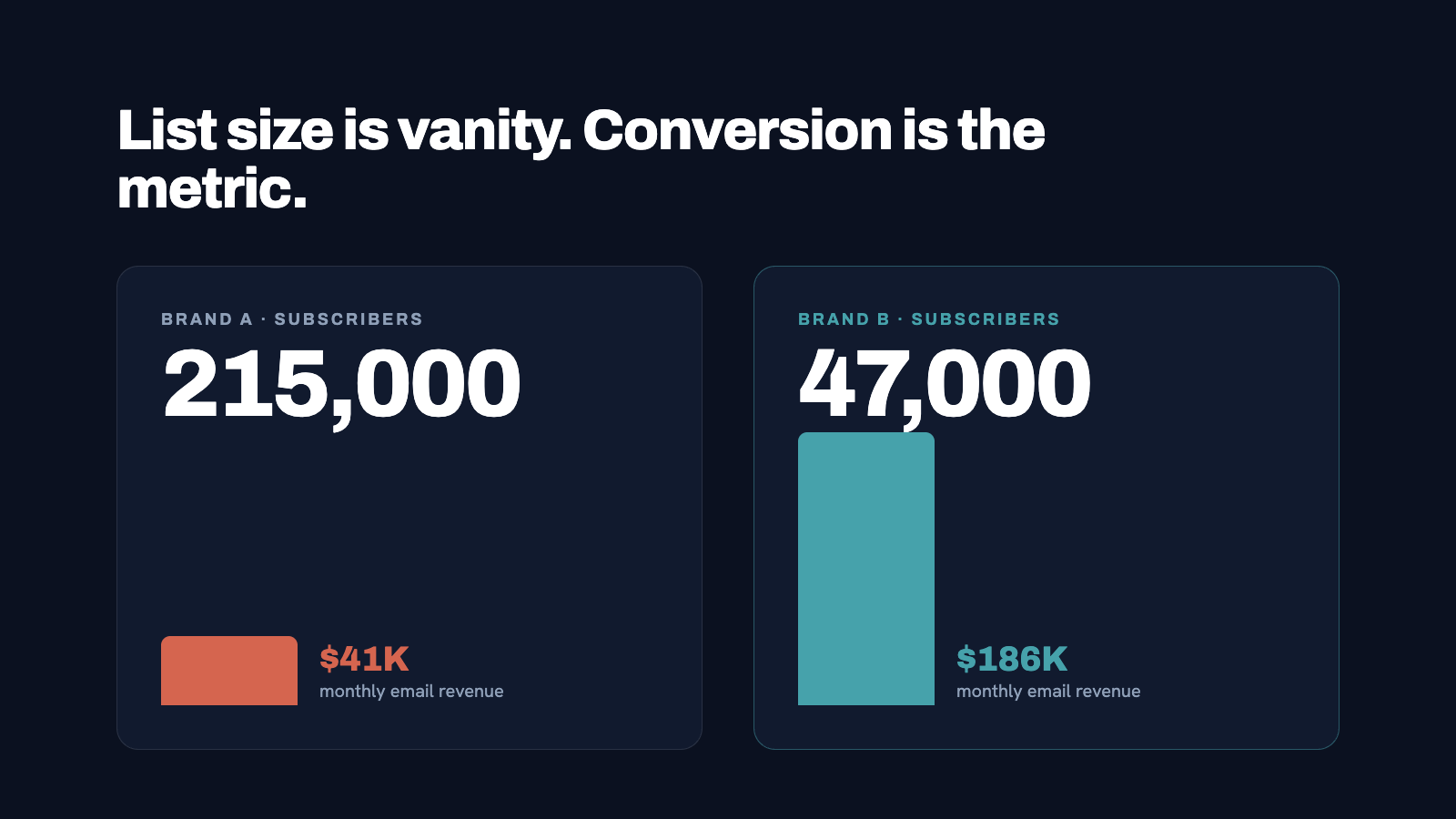
Some DTC brands have email lists with hundreds of thousands of subscribers. Impressive numbers on a dashboard. And if you look at their revenue per recipient, their repeat purchase rate, and their Klaviyo attribution - sometimes the numbers barely move.
A large email list that doesn't convert isn't an asset. It's a liability. You're paying to store those addresses, your deliverability is being dragged down by unengaged contacts, and your open rates are making your campaigns look worse than they are.
The goal isn't list growth. The goal is building a list of people who buy.
Most DTC brands accidentally build two lists at the same time.
List 1: People who will buy. They opted in because they were genuinely interested in what you sell. They opened the first email. They clicked through. They maybe bought already or they're close. This is the list that drives revenue.
List 2: People who won't. They signed up for a discount and never used it. They clicked something once a year ago. They're still on your list because you've never cleaned it. They're dragging down your open rates and telling inbox providers your emails aren't worth delivering.
The problem isn't that the second list exists - it's that most brands treat both lists exactly the same way. Same campaigns, same frequency, same messaging. And wonder why conversion rates are low.
List quality starts at the opt-in. If you're attracting the wrong people from the beginning, no amount of email strategy fixes the downstream problem.
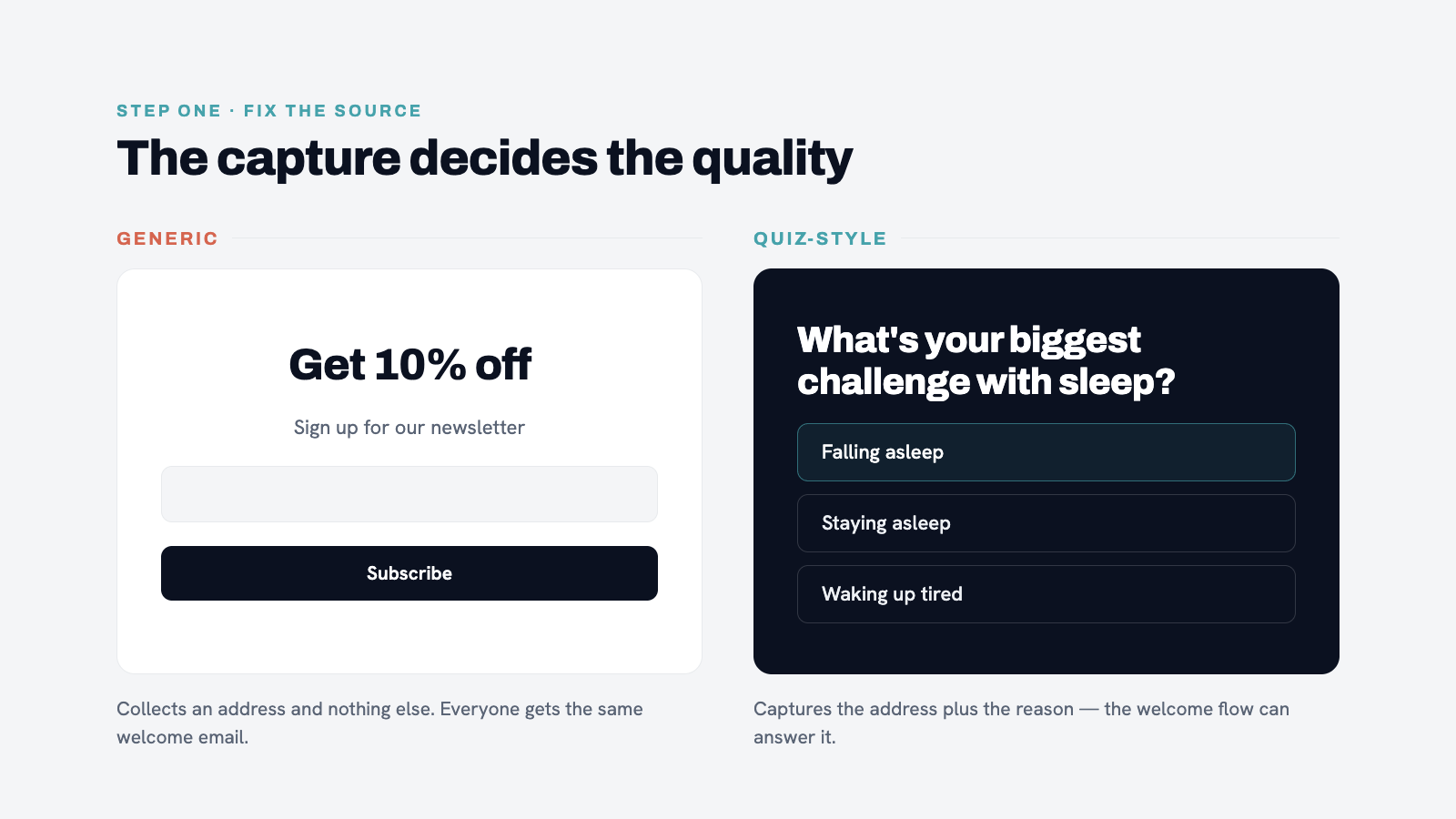
Offer a lead magnet that attracts buyers, not bargain hunters. A generic 10% off discount attracts everyone with an email address. A specific, relevant lead magnet - a guide, a quiz result, a product recommendation - attracts people who are actually interested in what you sell.
Match the opt-in offer to your products. The closer the relationship between what you're offering to capture the email and what you're selling, the higher the quality of subscriber you'll attract. A fitness brand offering a free workout plan attracts a different subscriber than one offering a promo code.
Use a quiz funnel for segmentation at capture. A three-question quiz before the opt-in tells you who each subscriber is before they ever buy. A golfer's handicap. A fitness level. A skin type. That data personalizes every email from message one - and it attracts people who are genuinely curious about the product, not just hunting for a discount.
The best opt-in strategy in the world still leaves you with a list of people who haven't bought yet. The welcome flow is the conversion engine.
Here's what determines whether a subscriber converts or goes cold:
Speed. The first email should send within five minutes of opt-in. Not one hour. Not "when our campaign goes out tomorrow." Five minutes.
Relevance. The first email should reference why they signed up. If they came in through a product-specific ad, say so. If they completed a quiz, acknowledge what they told you.
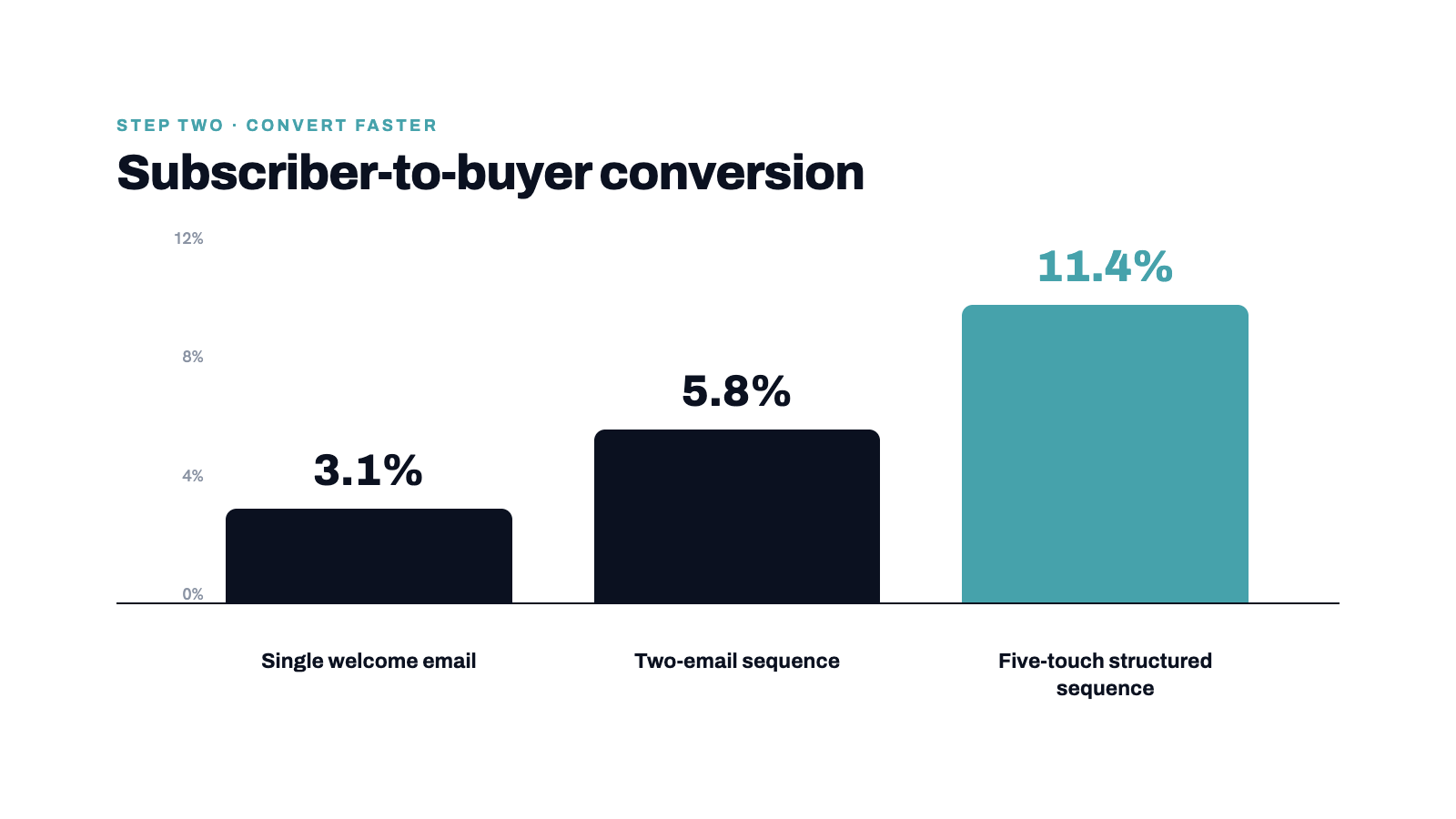
Sequence, not broadcast. A five-touch welcome sequence converts at twice the rate of a two-email default. Not because it sends more, but because each message is doing a specific job in a deliberate progression from interest to purchase.
A path for non-converters. Subscribers who reach day seven without buying should be tagged and routed into a different track - not abandoned. They're longer-consideration buyers, not lost causes.
A list that converts today but isn't maintained will stop converting. Three things keep it healthy:
Regular re-engagement campaigns. Every 90 days, send a specific re-engagement email to subscribers who haven't opened or clicked. Give them a reason to stay engaged or an easy way to update their preferences. The ones who don't respond at all are candidates for sunset.
A sunset flow. Subscribers who haven't opened or clicked in 90 to 180 days should enter a sunset flow - a short sequence that gives them one last chance to confirm they want to keep hearing from you. Remove those who don't. Your deliverability improves. Your open rates improve. Your conversions improve.
Suppression of recent buyers from acquisition campaigns. Customers who bought last week should not be receiving prospecting campaigns. They're in a post-purchase sequence. Treating them like cold leads trains them to ignore your emails and wastes spend.
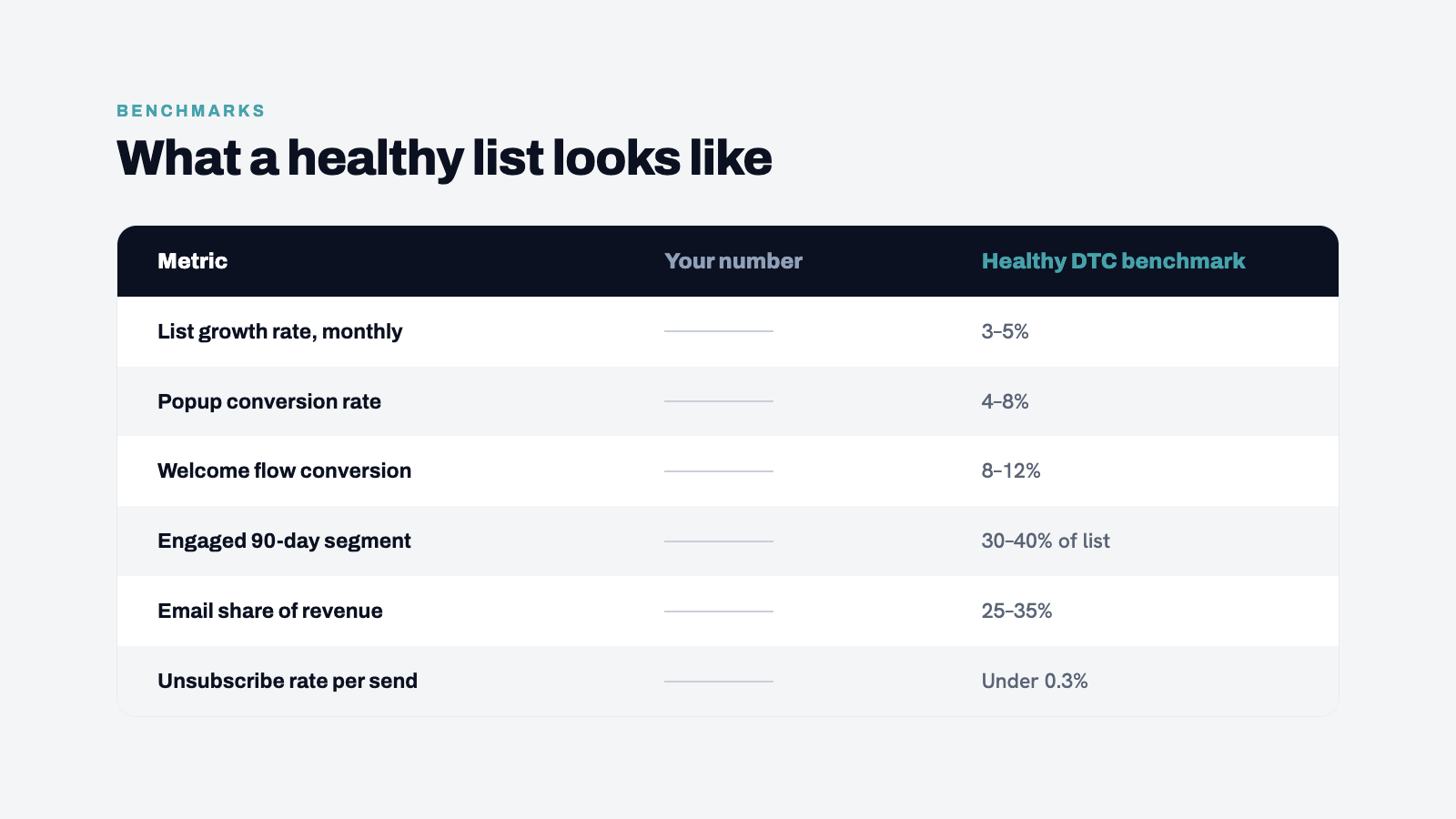
Benchmarks vary by category, but here's a rough picture of a healthy DTC email list in 2026:
• Open rate: 40-65% on campaigns (healthy deliverability, engaged audience)
• Click rate: above 1.5% on campaigns (indicating content relevance)
• Placed order rate: 0.05%+ on campaigns (indicating offer and CTA quality)
• Revenue per recipient: above $0.10 on campaigns
• Unsubscribe rate: below 0.3% per send
• Flow revenue as % of total Klaviyo revenue: 35-50%+ (indicating automation is working)
If your list is significantly below these benchmarks on engagement metrics, you likely have a list health problem - too many unengaged contacts dragging everything down. If your metrics are strong but revenue per recipient is low, you have a conversion problem - engaged subscribers who aren't clicking through to buy.
Lorem ipsum dolor sit amet, consectetur adipiscing elit. Suspendisse varius enim in eros elementum tristique. Duis cursus, mi quis viverra ornare, eros dolor interdum nulla, ut commodo diam libero vitae erat. Aenean faucibus nibh et justo cursus id rutrum lorem imperdiet. Nunc ut sem vitae risus tristique posuere.Email Welcome Flow for Ecommerce: How to Convert Subscribers into First-Time Buyers
Lorem ipsum dolor sit amet, consectetur adipiscing elit. Suspendisse varius enim in eros elementum tristique. Duis cursus, mi quis viverra ornare, eros dolor interdum nulla, ut commodo diam libero vitae erat. Aenean faucibus nibh et justo cursus id rutrum lorem imperdiet. Nunc ut sem vitae risus tristique posuere.Ecommerce Email Flows: The 7 Automations Every DTC Brand Needs (2026 Guide)
Not sure if your list is working as hard as it should be?
Our growth diagnostic includes a full Klaviyo audit - list health, flow performance, campaign benchmarks. Free for qualified brands.
Book your free growth diagnostic →