Full Funnel Strategy
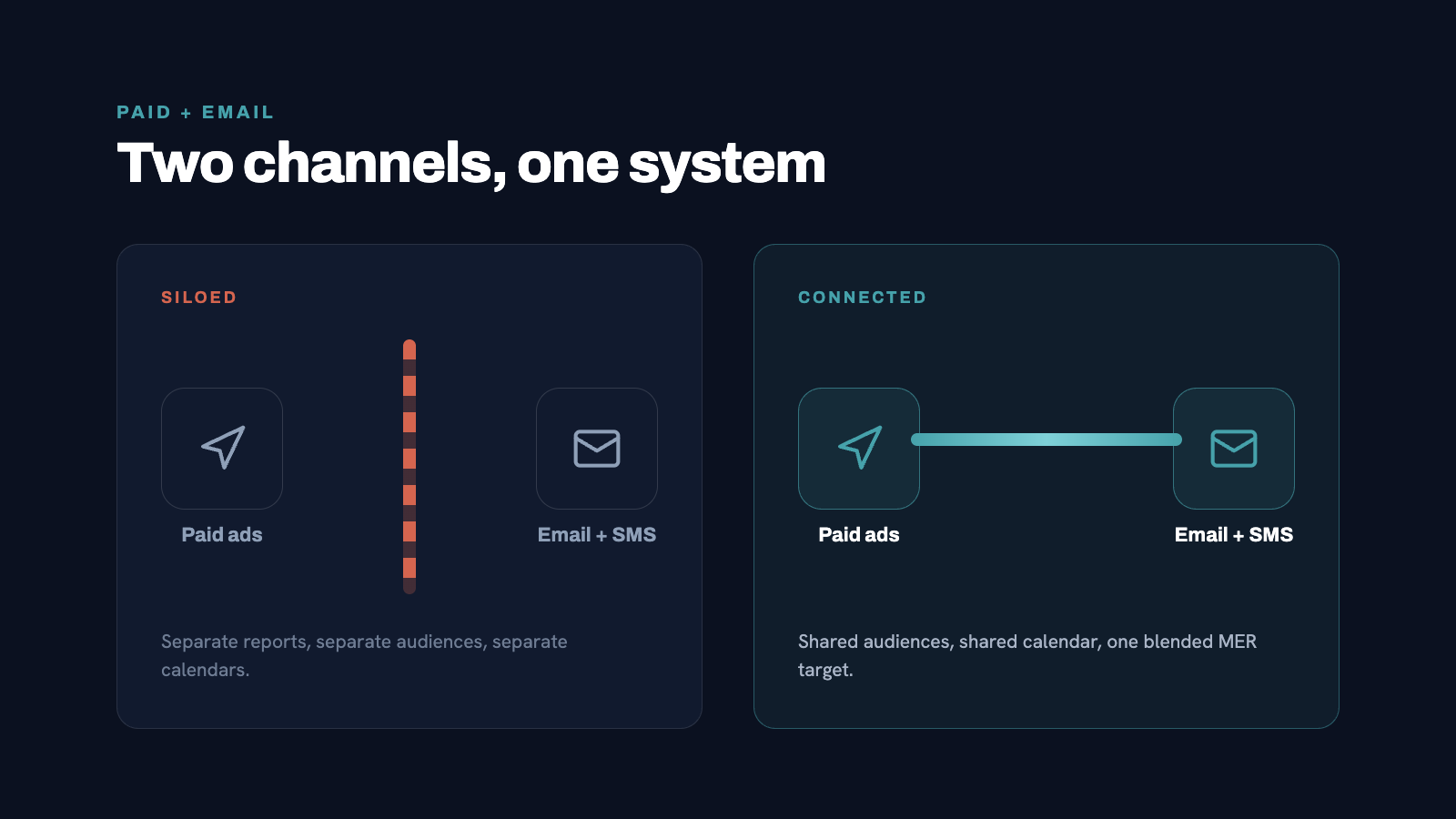
Ask most DTC brands to describe their marketing strategy and you'll get two answers. The paid person will tell you about ROAS, creative testing, and CPMs. The email person will tell you about open rates, flows, and campaign calendars. Both of them will be describing the same customer's journey - and neither of them will be able to see the whole thing.
That's the problem. Not the strategy. Not the spend level. The wall between two systems that should be one.
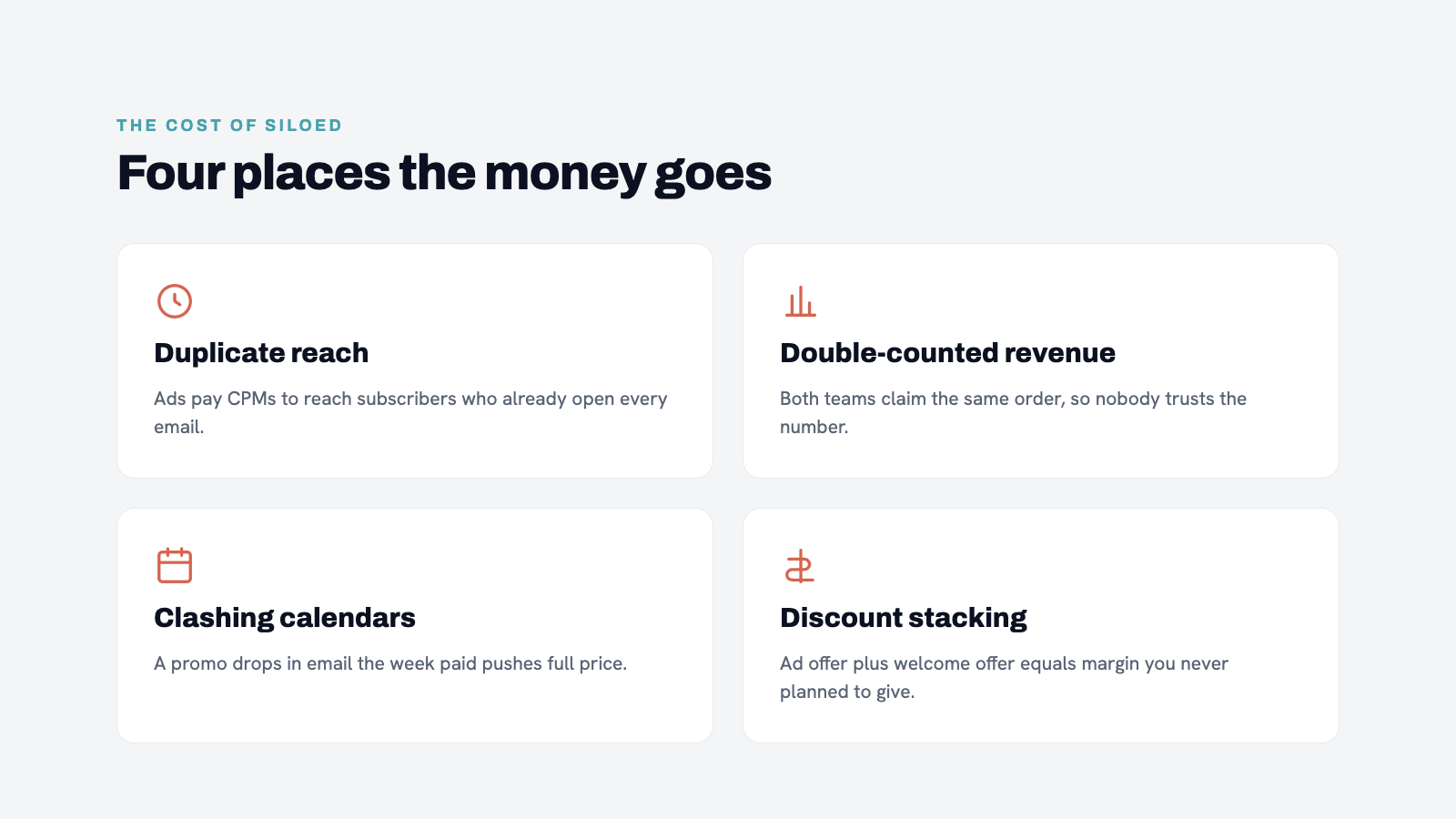
When paid acquisition and lifecycle marketing run as two separate systems, the cost shows up in four places:
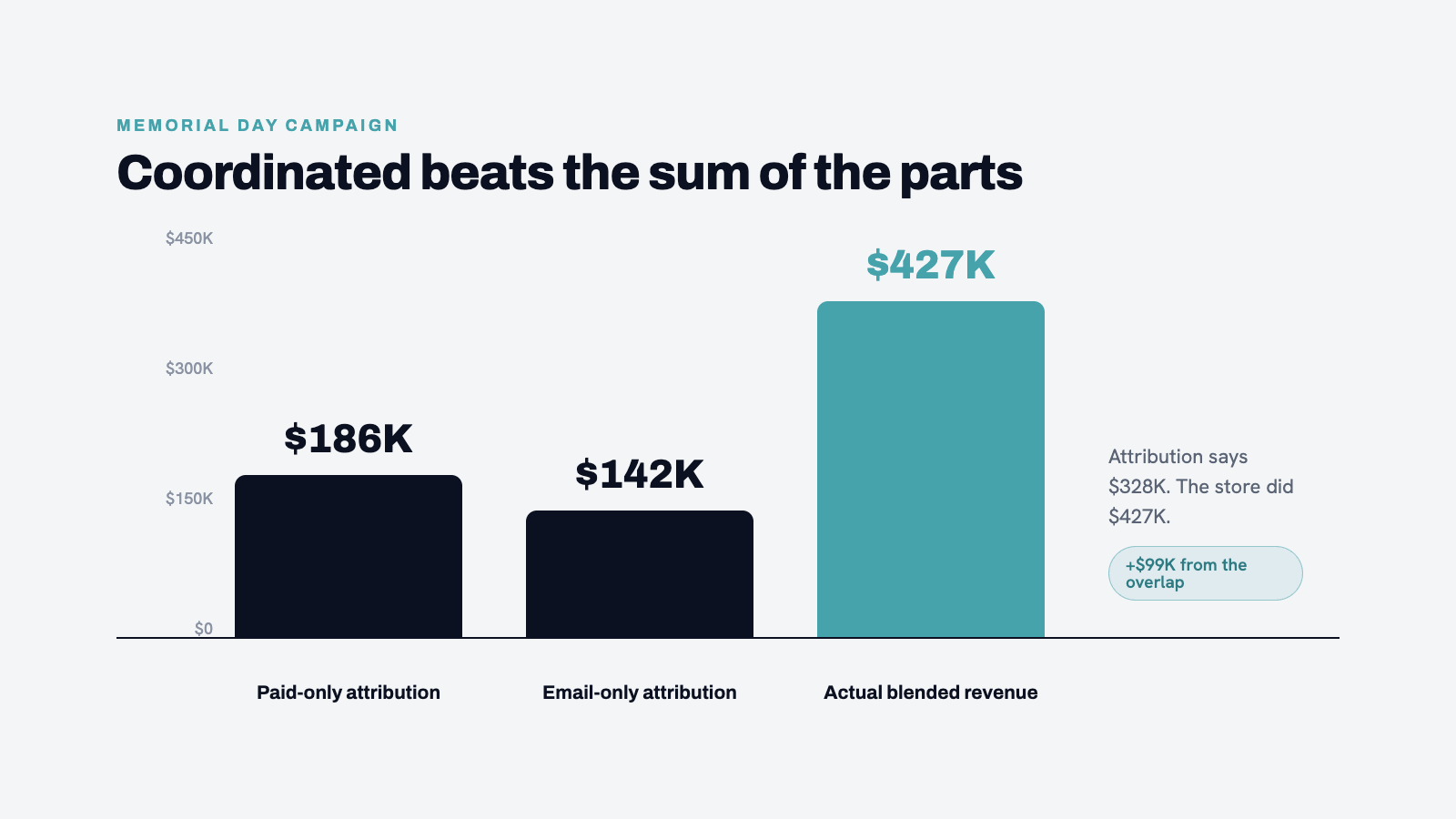
Double-counted attribution. Your ad platform claims the sale. Your email tool claims the same sale. Neither is lying - they're both using their own attribution model. But when you add them up, you've attributed more than 100% of your revenue, and budget decisions get made on inflated numbers.
Generic onboarding. The customer who clicked your ad about a specific product or offer lands in a welcome email that has nothing to do with why they bought. The connection between the promise that acquired them and the message that follows it is broken.
Winback that fires too late. Your email program doesn't know which customers came from a high-value paid campaign and are showing early churn signals. So they get the same generic 60-day winback email as everyone else - weeks after the window to save them closed.
Spend decisions based on half the picture. The paid team is scaling based on platform ROAS. The email team is reporting on attributed email revenue. Neither of them has a view of the customer's full value. So neither of them can make the right decision about where the next dollar should go.
Full Funnel Fusion is what happens when paid acquisition and retention marketing stop running as two separate playbooks and start operating as one system - same data, same strategy, same team.
Here's what concretely changes:
The email sequence knows what the ad said. When your ad platform and your email tool share data, the welcome flow knows which campaign, offer, and creative angle brought each customer in. The first email can reference it. The product recommendation on day 21 can be filtered by it. The sequence becomes a continuation of the conversation the ad started.
One blended metric governs all budget decisions. Instead of three dashboards claiming three different versions of your revenue, you use a single number - total revenue against total spend - to decide whether to scale or hold. No channel can quietly take credit for another's work.
Retargeting audiences are built from lifecycle data. Customers in an active post-purchase sequence are suppressed from prospecting ads. High-value segments feed lookalike audiences. The email list and the ad account share the same customer graph.
Every campaign is a full-funnel event. When you run a sale or a product launch, the paid and email sides execute together - ad creative and email subject lines carry the same message, landing pages match the campaign angle, and the post-event follow-up email retains the buyers the ads converted.
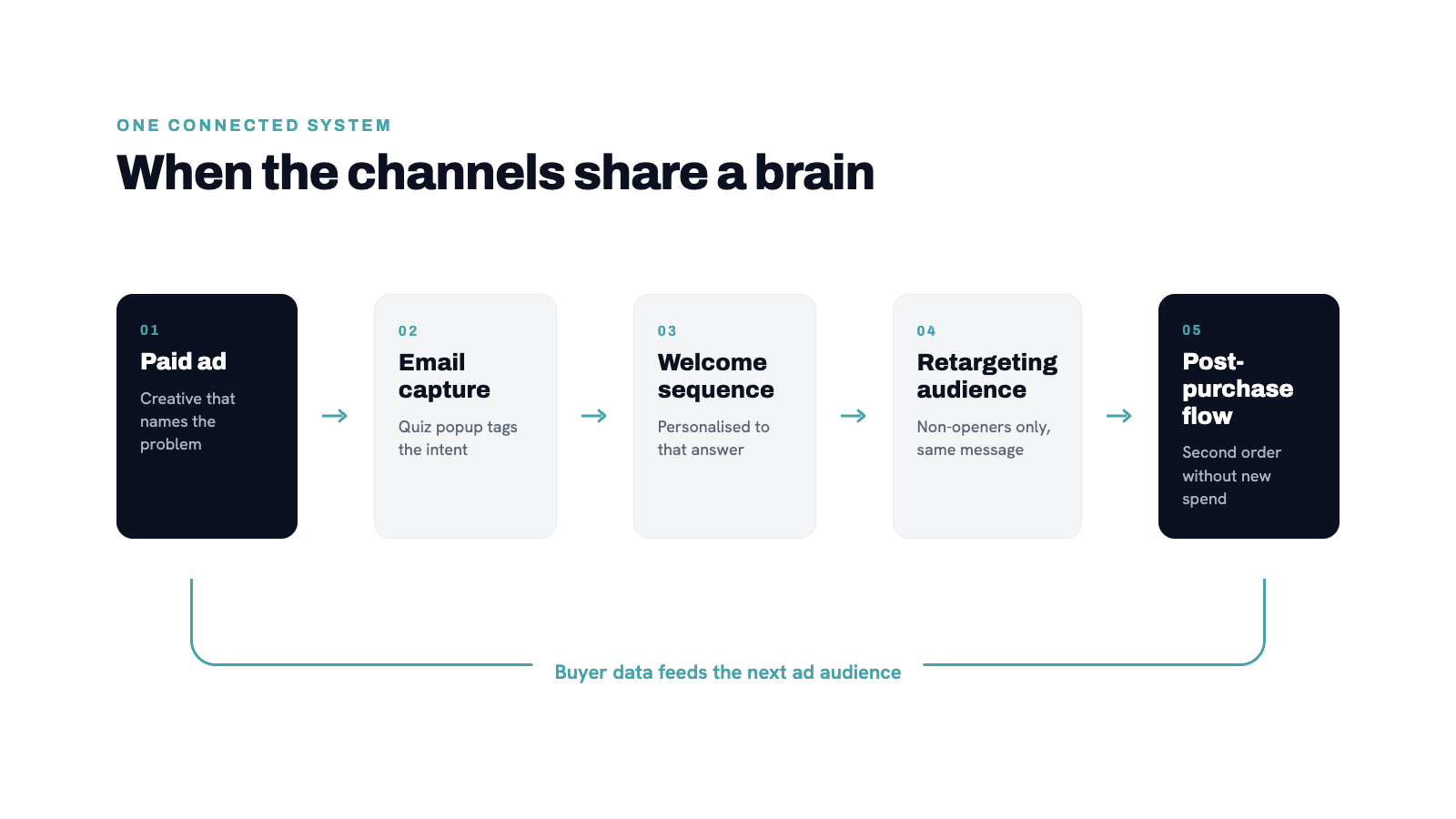
Here's what a fully connected campaign looks like in practice:
A DTC brand runs a Memorial Day sale. On the paid side, Carlos builds campaigns targeting warm audiences and lookalikes built from high-LTV customers. On the email side, the campaign goes to engaged segments with subject lines that mirror the ad creative angle. The landing page matches both.
The day after the sale, the post-purchase flow triggers for every buyer with messaging that references the offer they used. Three weeks later, buyers who haven't made a second purchase get a recommendation email for a complementary product - chosen based on what they bought during the sale.
Meanwhile, the paid team suppresses recent buyers from prospecting and retargets non-converters who saw the ad but didn't click. The email team segments by acquisition source to see which campaign cohort has the highest repeat rate - and feeds that back to paid to build better lookalikes.
That's one campaign. Two channels. One system. The results compound in a way that neither channel could produce alone.
Look at your last three promotional campaigns. For each one:
• Did the email subject line and the ad headline carry the same message?
• Did buyers from that campaign receive any post-purchase email that referenced the specific offer?
• Do you know the repeat purchase rate of customers acquired through that campaign vs. your baseline?
• Was your paid retargeting audience suppressed against recent email buyers?
If the answer to most of those is no, your paid and email channels are running in parallel - not together. The revenue difference between those two states is what Full Funnel Fusion closes.
Lorem ipsum dolor sit amet, consectetur adipiscing elit. Suspendisse varius enim in eros elementum tristique. Duis cursus, mi quis viverra ornare, eros dolor interdum nulla, ut commodo diam libero vitae erat. Aenean faucibus nibh et justo cursus id rutrum lorem imperdiet. Nunc ut sem vitae risus tristique posuere.What Is Marketing Efficiency Ratio (MER) - and Why Every DTC Brand Should Track It
Lorem ipsum dolor sit amet, consectetur adipiscing elit. Suspendisse varius enim in eros elementum tristique. Duis cursus, mi quis viverra ornare, eros dolor interdum nulla, ut commodo diam libero vitae erat. Aenean faucibus nibh et justo cursus id rutrum lorem imperdiet. Nunc ut sem vitae risus tristique posuere.Customer Retention vs Acquisition: Why DTC Brands Need Both to Scale Profitably
What would your numbers look like if both channels worked as one?
Our growth diagnostic maps your current setup and shows you exactly where the coordination gap is costing you.
Book your free growth diagnostic →