Paid Media Strategy
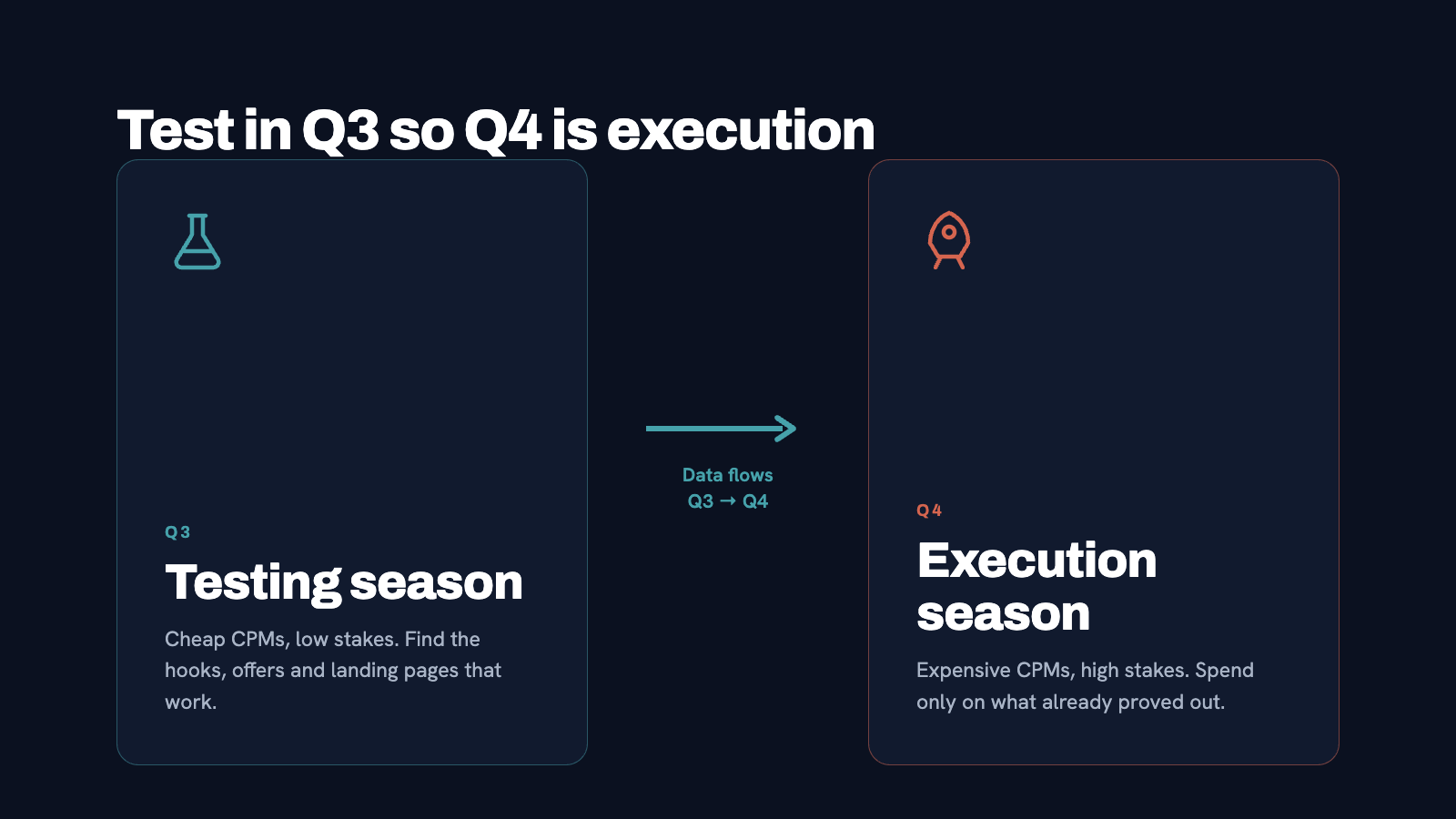
Q3 occupies a specific place in the DTC calendar. Volumes are lower. Competition in the auction is lower. CPMs are more forgiving. Stakes are lower.
These aren't negatives. They're advantages - if you use them the right way.
Q3 is the best testing environment of the year because every learning you generate costs less and carries less risk than the same test run in Q4. The brands that walk into November with a clear picture of what creative, what audiences, and what structures work in their account outperform those flying blind into BFCM every single time.
Creative angles. You need at minimum eight distinct hook types tested before BFCM. Problem/solution, social proof, product demo, UGC testimonial, results reveal, comparison, origin story, direct offer. Know which resonates with your audience before you're paying peak CPMs to find out.
Audience structures. Test broad targeting against interest-based targeting for your category. Test Meta's new customer purchase optimization against manual audience exclusions. Know which approach wins in your specific account.
Campaign structures. Q3 is the time to simplify. Overlapping ad sets fragment learning. Test a consolidated structure now so you're not making structural changes under pressure in October.
Incrementality. Q3 is the best time to run Meta's incrementality measurement tools. Understanding the true lift effect of your campaigns - what would have happened anyway vs. what your ads actually caused - gives you a more accurate basis for Q4 budget decisions.
Landing pages. Test different landing page approaches for your primary BFCM products now. A landing page that converts at 3% versus 2.5% represents a meaningful improvement in your Q4 CPA.
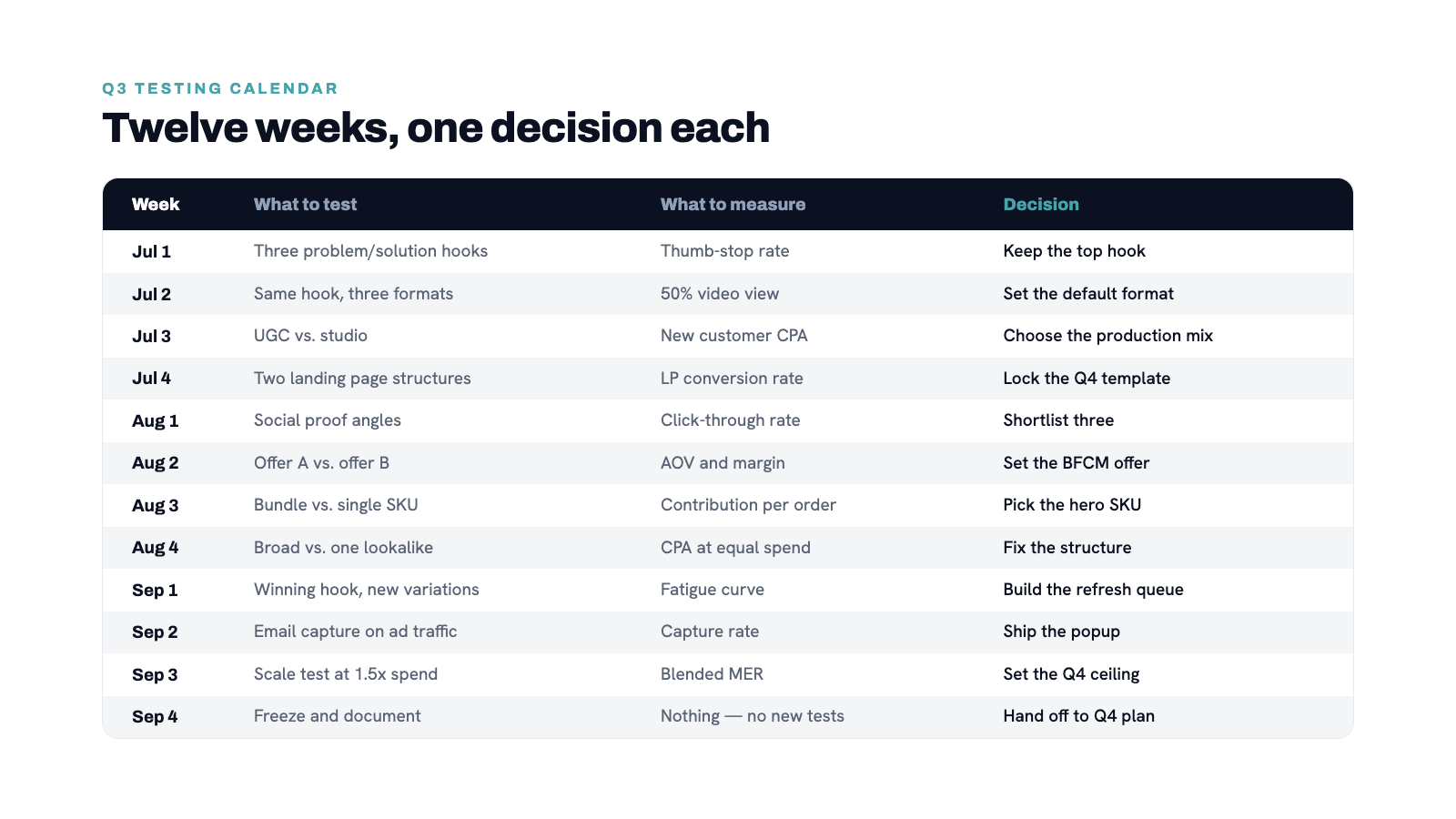
Most brands produce test results but don't know how to read them. A few principles:
Give tests enough time. A Meta campaign needs a minimum of seven days and 50 conversion events to exit the learning phase. Tests run for three days with five conversions are not statistically meaningful.
Compare the right metric to the right decision. Creative angle tests should be read on thumb-stop rate and landing page CTR. Audience structure tests should be read on new-customer CPA. Campaign structure tests should be read on blended account MER, not individual ROAS.
Document findings explicitly. The goal of Q3 testing is to walk into Q4 with documented answers to specific questions. Findings that live in someone's head are not useful when BFCM week arrives and attention is divided.
By September 30, you should have answers to:
• Which creative hooks perform best in our account?
• What audience structure wins in our specific category?
• How does our platform ROAS relate to our actual blended MER?
• What does our landing page conversion rate look like at steady state?
• What does our welcome flow convert at for paid traffic vs. organic?
These answers determine your Q4 budget, creative production plan, campaign structure, and landing page priorities. Getting them in Q3 means Q4 is execution - not figuring things out in real time at peak CPM.
Lorem ipsum dolor sit amet, consectetur adipiscing elit. Suspendisse varius enim in eros elementum tristique. Duis cursus, mi quis viverra ornare, eros dolor interdum nulla, ut commodo diam libero vitae erat. Aenean faucibus nibh et justo cursus id rutrum lorem imperdiet. Nunc ut sem vitae risus tristique posuere.Q3 Is BFCM Prep Season: What Smart DTC Brands Are Doing Right Now
Lorem ipsum dolor sit amet, consectetur adipiscing elit. Suspendisse varius enim in eros elementum tristique. Duis cursus, mi quis viverra ornare, eros dolor interdum nulla, ut commodo diam libero vitae erat. Aenean faucibus nibh et justo cursus id rutrum lorem imperdiet. Nunc ut sem vitae risus tristique posuere.Meta's AI Targeting in 2026: What DTC Brands Need to Know Before Q4
Want help building a Q3 testing plan that sets up a profitable Q4?
Book your free growth diagnostic →