Analytics
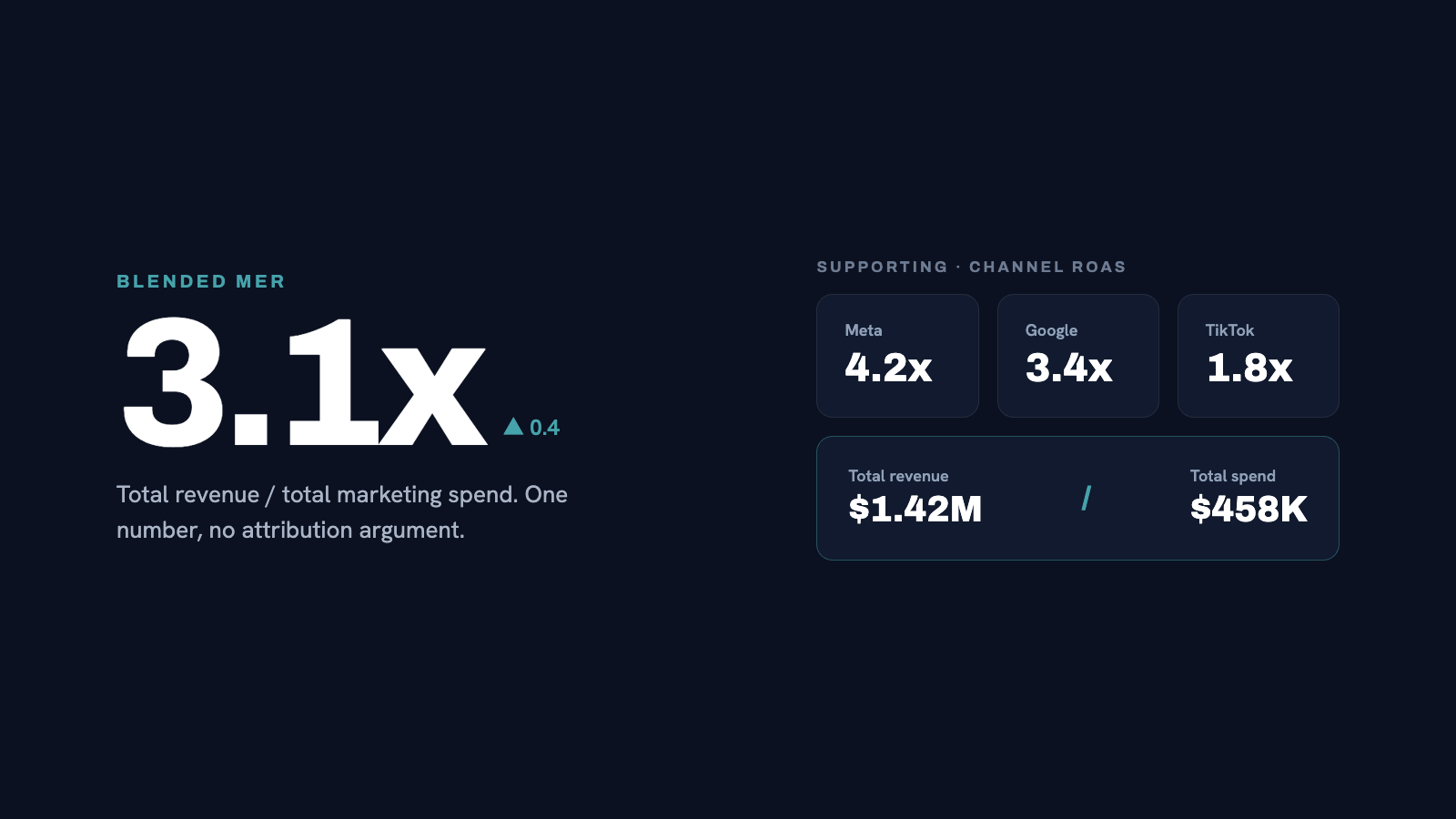
Every DTC brand tracks ROAS. Most track it by channel. Some track it by campaign. Very few track the one number that actually tells you whether the whole system is working.
That number is MER - Marketing Efficiency Ratio. And it's the simplest, most honest metric in your marketing stack.
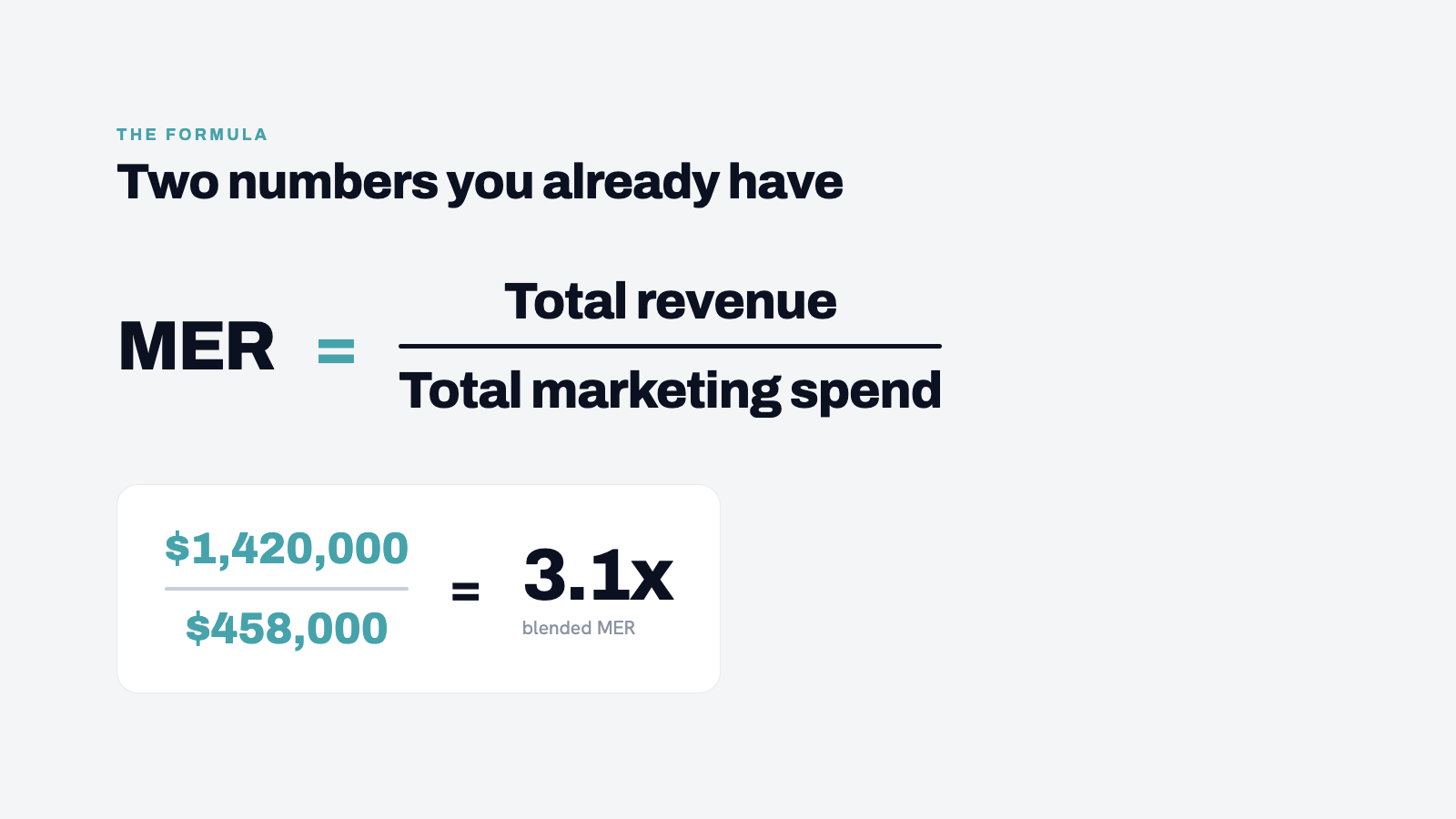
MER = Total Revenue / Total Marketing Spend
That's it. Total revenue from your business, divided by everything you spent on marketing to generate it.
If your brand did $400,000 in revenue last month and you spent $100,000 on marketing - Meta, Google, email tools, agency fees, everything - your MER is 4.0x.
No attribution model. No last-click weighting. No platform modeling. Total output divided by total input.
Platform-reported ROAS overstates performance for most DTC brands - by 15 to 40% depending on the brand, category, and attribution window. There are three reasons:
iOS privacy changes. Meta and other platforms have lost direct visibility into a significant portion of conversions. They fill the gap with modeled data - statistical estimates that tend to favor the platform reporting them.
Cross-device attribution. A customer sees an ad on their phone, thinks about it, and buys on their laptop three days later. The connection between those two events is often lost, misattributed, or duplicated.
Multi-channel overlap. Your Meta ad, your email campaign, your Google Shopping listing, and your organic post may all have touched the same customer before they purchased. Each channel claims the conversion according to its own model. When you add them up, you've often attributed more revenue than you actually made.
MER sidesteps all of this. It doesn't care about attribution. It measures what the business produced.
Set a target MER for your business. This varies by margin profile, AOV, and growth stage. A brand with 60% gross margins can sustain a lower MER than one at 40%. Start by calculating your break-even MER - the ratio at which your marketing spend is covered by contribution margin - and set your target above it.
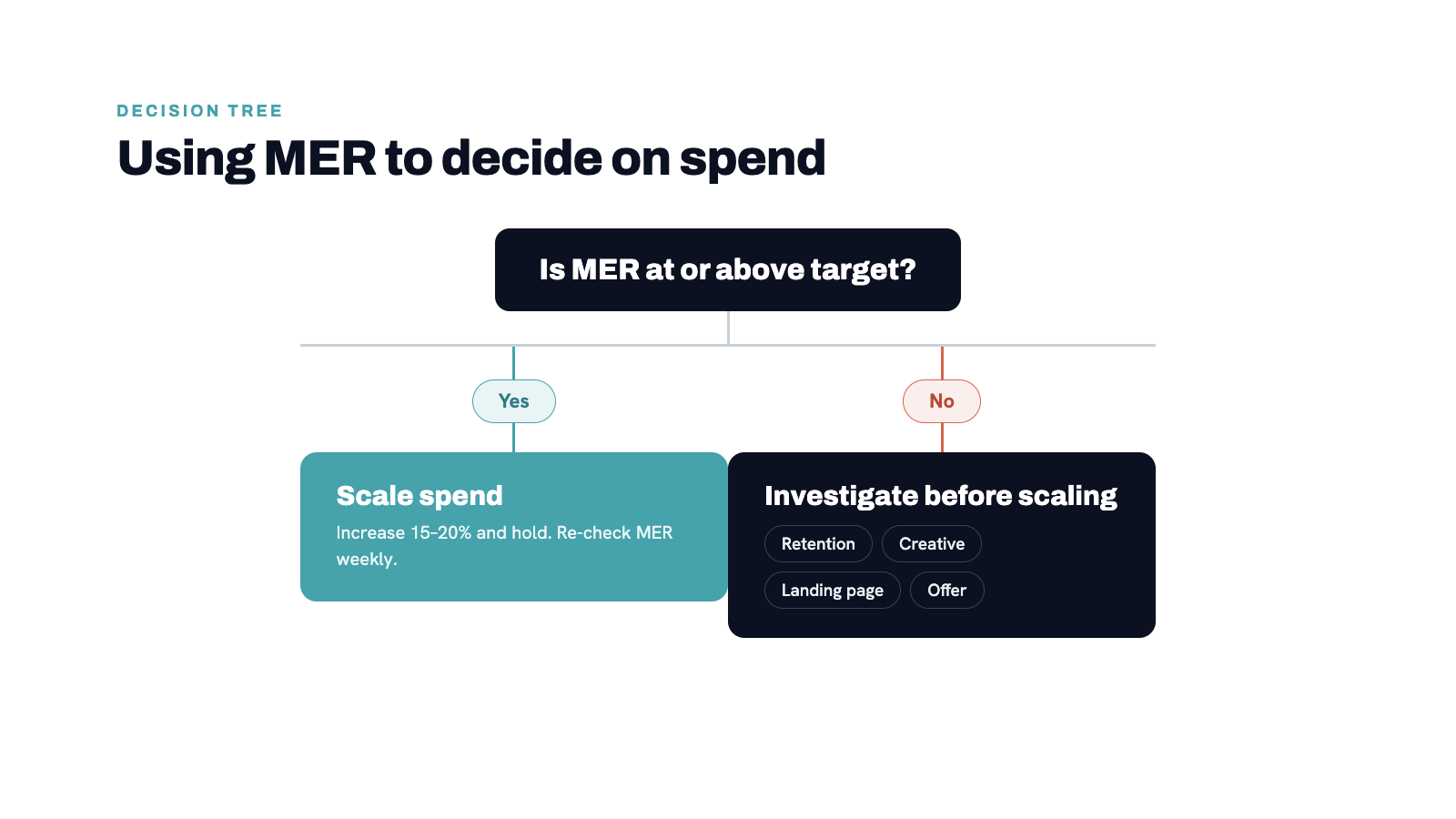
Use MER to decide whether to scale or hold. If your MER is at or above target, you have room to scale spend. If it's compressing, stop before you add more fuel to the fire. The signal is clear and doesn't require triangulating five dashboards.
Track MER monthly. Day-to-day MER fluctuates too much to be useful. Monthly gives you a signal you can act on without whiplash.
Use platform ROAS comparatively, not absolutely. Within the same platform, ROAS comparisons between campaigns are still meaningful. You're measuring against the same methodology, so relative performance is valid even if the absolute number is overstated. Use ROAS to decide which campaign is winning, and MER to decide whether the whole program is working.
A high platform ROAS with a low MER means one of a few things:
• Email, organic, or repeat behavior is generating revenue that paid is taking credit for
• Your retention program is weak and customers aren't returning after the first purchase
• Your attribution window is too long and you're double-counting conversions
• Your paid spend is efficient in the platform but not moving the overall business needle
A healthy MER with a mediocre platform ROAS might mean your attribution window is conservative, your email program is pulling significant weight, or your organic traffic is strong - all of which are good problems to have.
The MER tells you the health of the business. Platform ROAS tells you about one channel's self-reported performance. You need both, but you should make decisions off the first one.
Here's the part most paid-only agencies never explain to their clients.
Retention directly improves MER - not as a side effect, but as a mechanism. When your email program generates repeat purchase revenue, that revenue goes into the numerator of your MER calculation without any additional ad spend in the denominator. Every dollar your flows and campaigns generate improves your MER for free.
This is why a brand with a strong retention program can afford to pay more to acquire a customer - their MER stays healthy because the back half of the funnel is doing real work. A brand with weak retention needs a higher platform ROAS just to stay afloat.
Lorem ipsum dolor sit amet, consectetur adipiscing elit. Suspendisse varius enim in eros elementum tristique. Duis cursus, mi quis viverra ornare, eros dolor interdum nulla, ut commodo diam libero vitae erat. Aenean faucibus nibh et justo cursus id rutrum lorem imperdiet. Nunc ut sem vitae risus tristique posuere.What Is Marketing Efficiency Ratio (MER) - and Why Every DTC Brand Should Track It
Lorem ipsum dolor sit amet, consectetur adipiscing elit. Suspendisse varius enim in eros elementum tristique. Duis cursus, mi quis viverra ornare, eros dolor interdum nulla, ut commodo diam libero vitae erat. Aenean faucibus nibh et justo cursus id rutrum lorem imperdiet. Nunc ut sem vitae risus tristique posuere.Full-Funnel Ecommerce Marketing: How to Connect Paid Ads and Email for Higher MER
Want to know your real MER - and what's driving the gap between it and your platform ROAS?
Our growth diagnostic includes a full attribution review. Free for qualified brands.
Book your free growth diagnostic →