Paid Media Strategy
There's a shift that's been underway on Meta for the last two years, and brands that haven't adjusted their approach are paying more to reach worse audiences.
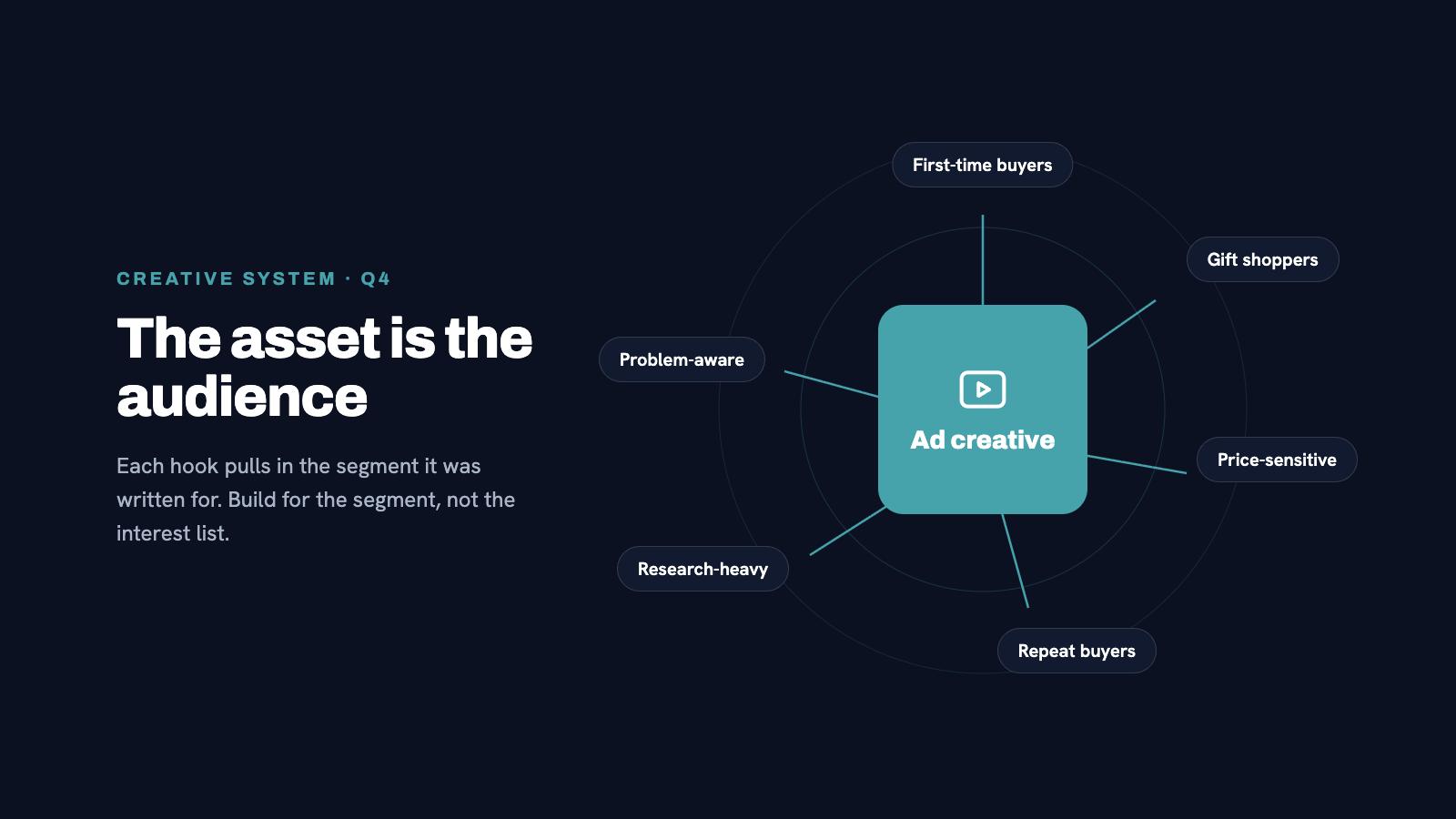
Creative used to be the thing that convinced your audience to buy. Today it's also the mechanism by which Meta identifies who your audience is. The implication changes almost everything about how you approach ad production and testing.
When you run a broad targeting campaign on Meta - minimal audience restrictions, Advantage+ placement - the algorithm needs to decide who to show your ad to. It uses your creative to make that decision.
A video that shows a problem your product solves signals the people who have that problem. A testimonial from a specific customer type attracts similar customers. A product shot styled for a particular aesthetic finds people who respond to that aesthetic.
This means your creative brief is, in effect, your targeting brief. What you show in the first three seconds of a video determines who Meta puts it in front of. The wrong creative finds the wrong audience at any budget level.
Building a creative system - not just running ads - requires three things:
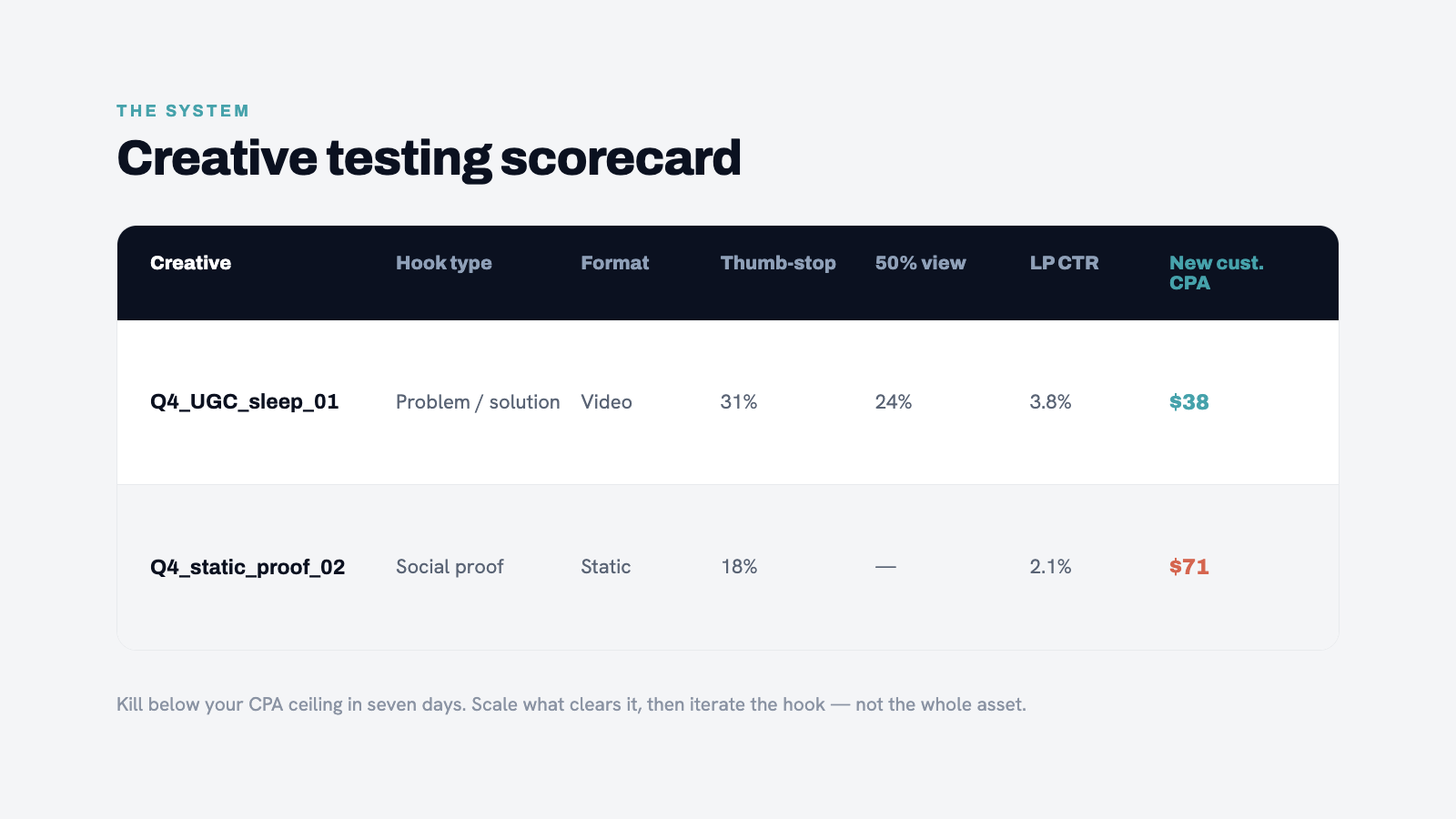
A hook library. The first two to three seconds of any video ad determines whether the algorithm places it in front of a relevant audience and whether the viewer keeps watching. Build and test a minimum of eight distinct hook types: problem/solution, social proof quotes, product demos, results reveals, UGC testimonials, comparison, story-led, and direct offer. Know which hook type wins in your account before Q4.
A regular production cadence. Ad fatigue - the performance decay that happens when the same creative runs too long - is the primary cause of rising CPMs for most DTC brands. Creative needs to rotate consistently. A minimum of four net-new creative concepts per month going into Q4 is a reasonable floor for brands spending above $10K/month.
A reading framework. Most brands produce creative and optimize based on ROAS. That's the wrong metric for creative decisions. Read creative performance by: thumb-stop rate (first three seconds), video view rate (25%, 50%, 75%), landing page CTR, and new-customer CPA. Each tells you something different about where the creative is winning or losing.
For Q4 specifically - BFCM, holiday, year-end - offer-based creative performs differently than evergreen brand creative. Key principles:
• Limited-time language outperforms "always on" language at this time of year
• Specific offers ("30% off everything through midnight") outperform vague ones ("big savings")
• UGC-style creative tends to outperform polished brand creative during BFCM because it feels less "salesy" in a feed full of ads
• Real scarcity (actual limited inventory, real deadline) dramatically outperforms manufactured urgency
Build your Q4 offer creative in September. Test the hooks in October. Enter November knowing what works.
Lorem ipsum dolor sit amet, consectetur adipiscing elit. Suspendisse varius enim in eros elementum tristique. Duis cursus, mi quis viverra ornare, eros dolor interdum nulla, ut commodo diam libero vitae erat. Aenean faucibus nibh et justo cursus id rutrum lorem imperdiet. Nunc ut sem vitae risus tristique posuere.Meta's AI Targeting in 2026: What DTC Brands Need to Know Before Q4
Lorem ipsum dolor sit amet, consectetur adipiscing elit. Suspendisse varius enim in eros elementum tristique. Duis cursus, mi quis viverra ornare, eros dolor interdum nulla, ut commodo diam libero vitae erat. Aenean faucibus nibh et justo cursus id rutrum lorem imperdiet. Nunc ut sem vitae risus tristique posuere.How to Use Q3 to Test Your Way Into a Profitable Q4
Lorem ipsum dolor sit amet, consectetur adipiscing elit. Suspendisse varius enim in eros elementum tristique. Duis cursus, mi quis viverra ornare, eros dolor interdum nulla, ut commodo diam libero vitae erat. Aenean faucibus nibh et justo cursus id rutrum lorem imperdiet. Nunc ut sem vitae risus tristique posuere.Ecommerce Email Flows: The 7 Automations Every DTC Brand Needs (2026 Guide)
Not sure if your creative strategy is ready for Q4?
Book your free growth diagnostic →